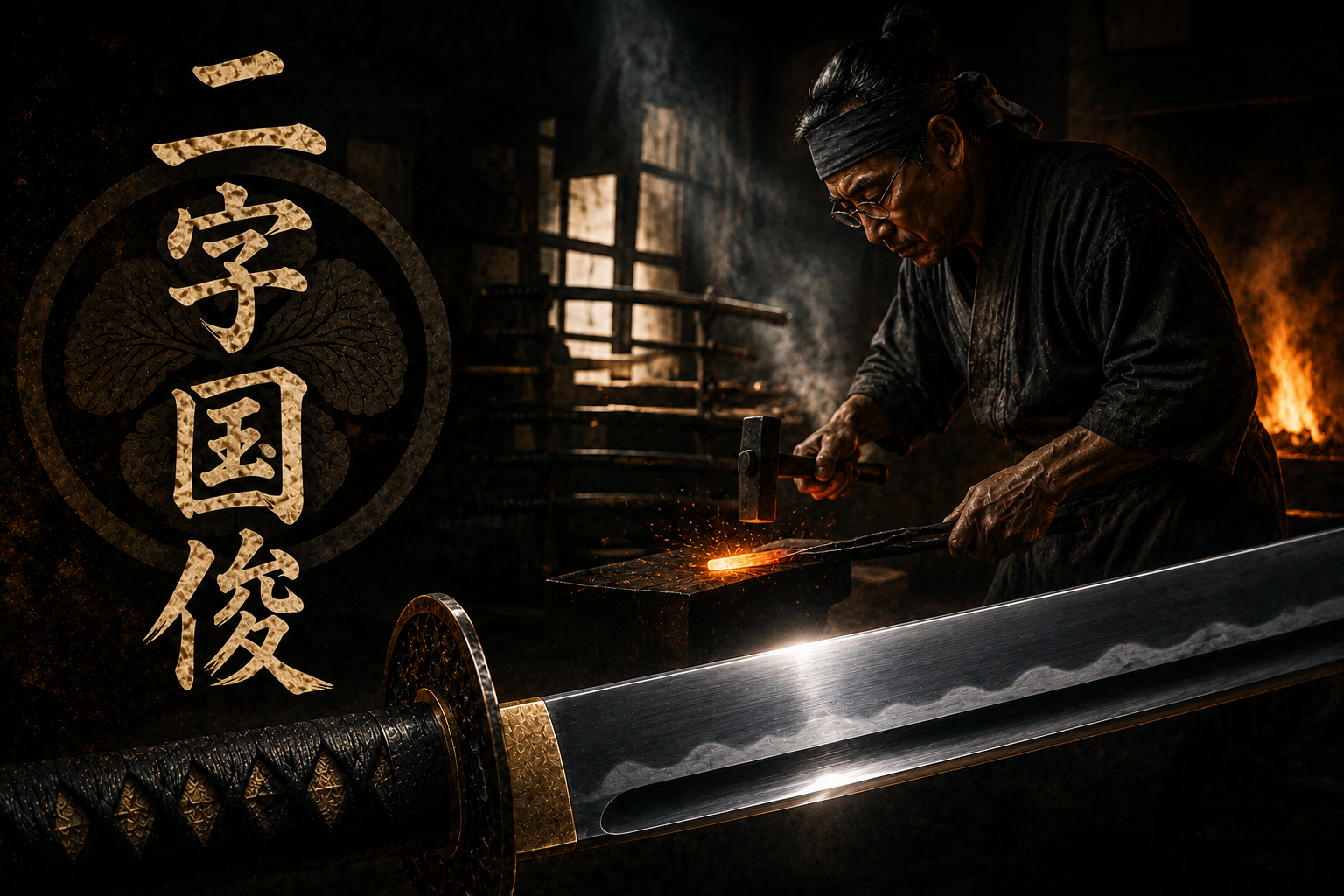
Niji Kunitoshi: The Enigmatic Swordsmith Behind Japan’s Greatest Blades
Few names in the world of Japanese swords carry as much mystery and reverence as Niji Kunitoshi. For centuries, collectors, scholars, and martial artists have debated his identity, marveled at his craftsmanship, and paid extraordinary sums for his surviving works. Yet despite his legendary status, many enthusiasts still struggle to separate fact from folklore when it comes to this iconic swordsmith. In this guide, we’ll explore everything you need to know about Niji Kunitoshi — his origins, his distinctive forging style, what sets his blades apart, and why they remain among the most coveted nihonto in existence.
Who Was Niji Kunitoshi?
The name “Niji Kunitoshi” (二字国俊) literally means “two-character Kunitoshi,” referring to the way this smith signed his blades with just two kanji characters: 国俊 (Kunitoshi). This seemingly simple detail is actually the crux of one of the longest-running debates in Japanese sword scholarship.
Niji Kunitoshi is traditionally associated with the Rai school (来派), one of the most prestigious lineages of swordsmiths based in Yamashiro Province (modern-day Kyoto). The Rai school flourished during the Kamakura period (1185–1333), an era widely considered the golden age of Japanese sword making. The school produced numerous master smiths, but Kunitoshi stands at the pinnacle alongside names like Rai Kunimitsu and Rai Kunitsugu.
The Identity Debate: One Smith or Two?
The central question that has occupied nihonto scholars for generations is whether Niji Kunitoshi and Rai Kunitoshi (来国俊) are the same person or two different smiths. Rai Kunitoshi signed his works with a longer inscription that included the “Rai” prefix, while Niji Kunitoshi used only the two characters of his given name.
Some experts argue that the differing signatures simply reflect different periods of the same smith’s career — perhaps a younger Kunitoshi signing briefly before adopting the fuller Rai lineage name. Others contend that the dramatic differences in forging style between blades signed “国俊” and those signed “来国俊” suggest they were crafted by entirely different hands. The Niji Kunitoshi blades tend to display a more flamboyant and dynamic temperament, often featuring bold chōji-midare (clove-pattern) hamon, while Rai Kunitoshi’s authenticated works lean toward refined suguha (straight temper line) patterns.
This debate remains unresolved, and it is precisely this ambiguity that adds to the allure of Niji Kunitoshi blades. Owning one means possessing a piece of a centuries-old enigma.
Characteristics of Niji Kunitoshi Blades
Regardless of the identity question, swords attributed to Niji Kunitoshi share a distinctive set of features that make them instantly recognizable to trained eyes. Understanding these characteristics is essential for anyone interested in kantei (appraisal) or collecting.
Sugata (Shape and Form)
Niji Kunitoshi tachi typically display the elegant proportions characteristic of mid-Kamakura period swords. They tend to have a graceful curvature (sori) with a slightly elongated kissaki (point). The width (mihaba) is often robust without being excessive, giving the blade a powerful yet balanced silhouette. Many surviving examples show a strong taper from the base (moto-haba) to the tip (saki-haba), a hallmark of classical Kamakura craftsmanship.
Jigane (Steel Surface)
The jihada (grain pattern) on Niji Kunitoshi blades is typically a fine ko-mokume (small burl wood grain) mixed with ko-itame (small wood grain). The jigane is remarkably clear and luminous, displaying ji-nie (individual martensite crystals visible on the surface) that give the steel a sparkling, almost celestial quality. This refined surface texture reflects the Rai school’s mastery of steel preparation and forge welding.
Hamon (Temper Pattern)
This is where Niji Kunitoshi truly distinguishes himself. While the broader Rai school is known for elegant suguha, many blades attributed to Niji Kunitoshi feature a vibrant chōji-midare hamon — an undulating clove-shaped temper pattern more commonly associated with the Bizen tradition. This stylistic crossover is remarkable and suggests either significant interaction between schools or an extraordinarily versatile smith willing to push beyond regional conventions.
The nie (martensite crystals) within the hamon tend to be bright and well-formed, contributing to dramatic visual effects like kinsuji (golden lines) and sunagashi (sweeping sand-like patterns) along the temper boundary.
Nakago (Tang) and Signature
The tang is typically finished in a manner consistent with Kamakura-period Yamashiro work — slightly tapered with kurijiri (chestnut-shaped end) or a similar classical shape. The two-character mei (signature) “国俊” is inscribed in a bold, confident hand. File marks (yasurime) are usually katte-sagari (slanting downward to the left), consistent with Rai school practices.
Cultural Significance and Designations
Blades attributed to Niji Kunitoshi hold an extraordinary place in Japanese cultural heritage. Several have been designated as Kokuhō (National Treasures) or Jūyō Bunkazai (Important Cultural Properties) by the Japanese government. These designations reflect not only superb craftsmanship but also historical significance and exceptional state of preservation.
Within the NBTHK (Society for the Preservation of Japanese Art Swords) classification system, Niji Kunitoshi blades frequently achieve the coveted Jūyō Tōken (Important Sword) designation and above. Several have reached Tokubetsu Jūyō (Especially Important) status, placing them in the highest tier of authenticated nihonto.
The provenance of these blades often traces through daimyō collections, imperial households, and renowned collectors. Each sword carries its own history — sometimes spanning seven or more centuries — of guardianship and appreciation.
Niji Kunitoshi’s Connection to the Broader Rai School
To fully appreciate Niji Kunitoshi, it helps to understand the Rai school’s place in the nihonto world. Founded in Yamashiro Province, the Rai school represented the aesthetic ideals of Kyoto’s aristocratic culture. Their blades embodied miyabi — courtly elegance — in contrast to the more martial aesthetics of provincial schools.
Key members of the Rai lineage include:
- Rai Kuniyuki — considered the school’s founder or early patriarch
- Rai Kunitoshi — the most celebrated smith bearing the Kunitoshi name (and possibly identical to Niji Kunitoshi)
- Rai Kunimitsu — renowned especially for tantō of extraordinary beauty
- Rai Kunitsugu — carried the school’s traditions into the Nanbokuchō era
The interplay between these smiths and their contemporaries in Bizen and Sōshū is a fascinating chapter in metallurgical and artistic history. The concept of sōden (transmitted traditions) — where techniques from one school influenced another — is clearly visible in Niji Kunitoshi’s chōji work, suggesting cross-pollination between Yamashiro and Bizen methodologies.
Collecting Niji Kunitoshi: What Enthusiasts Should Know
Authentic Niji Kunitoshi blades are exceptionally rare and command prices that reflect their status among the finest swords ever forged. For serious collectors, here are some key considerations:
- Authentication is paramount. Always look for NBTHK papers — ideally Jūyō or higher. Given the age and value of these blades, expert certification is non-negotiable.
- Condition matters enormously. Kamakura-period blades have survived roughly 700+ years. The degree of original steel remaining, the clarity of the hamon, and the integrity of the nakago all affect desirability.
- Provenance adds value. Documented ownership history, especially connections to notable collections, enhances both the scholarly and monetary worth of a blade.
- Study before you buy. Attend kantei sessions, read scholarly publications by authors like Honma Junji and Tanobe Michihiro, and handle as many authenticated blades as possible to develop your eye.
While genuine Niji Kunitoshi works appear on the market only rarely, collectors who appreciate the Rai school tradition can explore other authentic Japanese swords of exceptional quality. At Ifu, we offer carefully curated, high-quality authentic Japanese swords (nihonto) for collectors at every level — each one selected for its craftsmanship, condition, and historical integrity.
Why Niji Kunitoshi Still Captivates Us
In a discipline where provenance, technique, and aesthetics converge, Niji Kunitoshi represents something truly rare: a swordsmith whose work transcends categorization. His blades bridge the refined elegance of Yamashiro with the dynamic energy of Bizen, creating something that feels timeless and alive even after seven centuries. The unresolved questions surrounding his identity only deepen the fascination. Every Niji Kunitoshi blade that survives is not just a weapon or a work of art — it is an open question, an invitation to look closer, and a testament to the enduring genius of Japan’s greatest sword-making tradition.