Why the Munechika Sword Still Stuns After 1,000 Years
In the world of Japanese swords, few names carry as much reverence as Munechika. The blade most associated with this legendary swordsmith — the Mikazuki Munechika — has survived over a millennium and remains one of Japan’s most treasured national artifacts. But what makes this sword so extraordinary? Why does it continue to captivate collectors, historians, and martial arts enthusiasts a thousand years after it was forged?
In this article, we explore the history, craftsmanship, and enduring legacy of the Munechika sword, from the hands of the master who created it to the museum case where it rests today.
Who Was Sanjo Munechika?
To understand the sword, you must first understand the smith. Sanjo Munechika (三条宗近) was a swordsmith who worked in Kyoto during the late Heian period, roughly around the late 10th to early 11th century. He is considered one of the greatest swordsmiths in Japanese history and the founder of the Sanjo school of sword-making, named after the Sanjo district of Kyoto where he lived and worked.
Munechika’s era was a time of profound cultural refinement in Japan. The Heian court valued elegance and artistry in all things, and sword-making was no exception. Unlike later periods when swords were forged primarily as weapons of war, Heian-era blades often reflected a deep aesthetic sensibility. Munechika embodied this tradition — his works are celebrated not only for their functional quality but for their breathtaking beauty.
Legends Surrounding the Smith
One famous legend holds that Munechika received divine assistance while forging a blade commissioned by Emperor Ichijo. According to the tale, the fox deity Inari appeared as a mysterious assistant, helping Munechika strike the steel. The resulting sword was named Kogitsune-maru (“Little Fox”), and the story became the basis for the Noh play Kokaji. Whether myth or metaphor, such legends speak to the almost supernatural regard in which Munechika’s skill was held.
The Mikazuki Munechika: A National Treasure
Of all the blades attributed to Sanjo Munechika, the most famous is undoubtedly the Mikazuki Munechika (三日月宗近), whose name translates to “Crescent Moon Munechika.” This tachi — a style of curved sword worn edge-down — is designated as a National Treasure of Japan and is widely regarded as one of the finest swords ever produced.
Why Is It Called “Crescent Moon”?
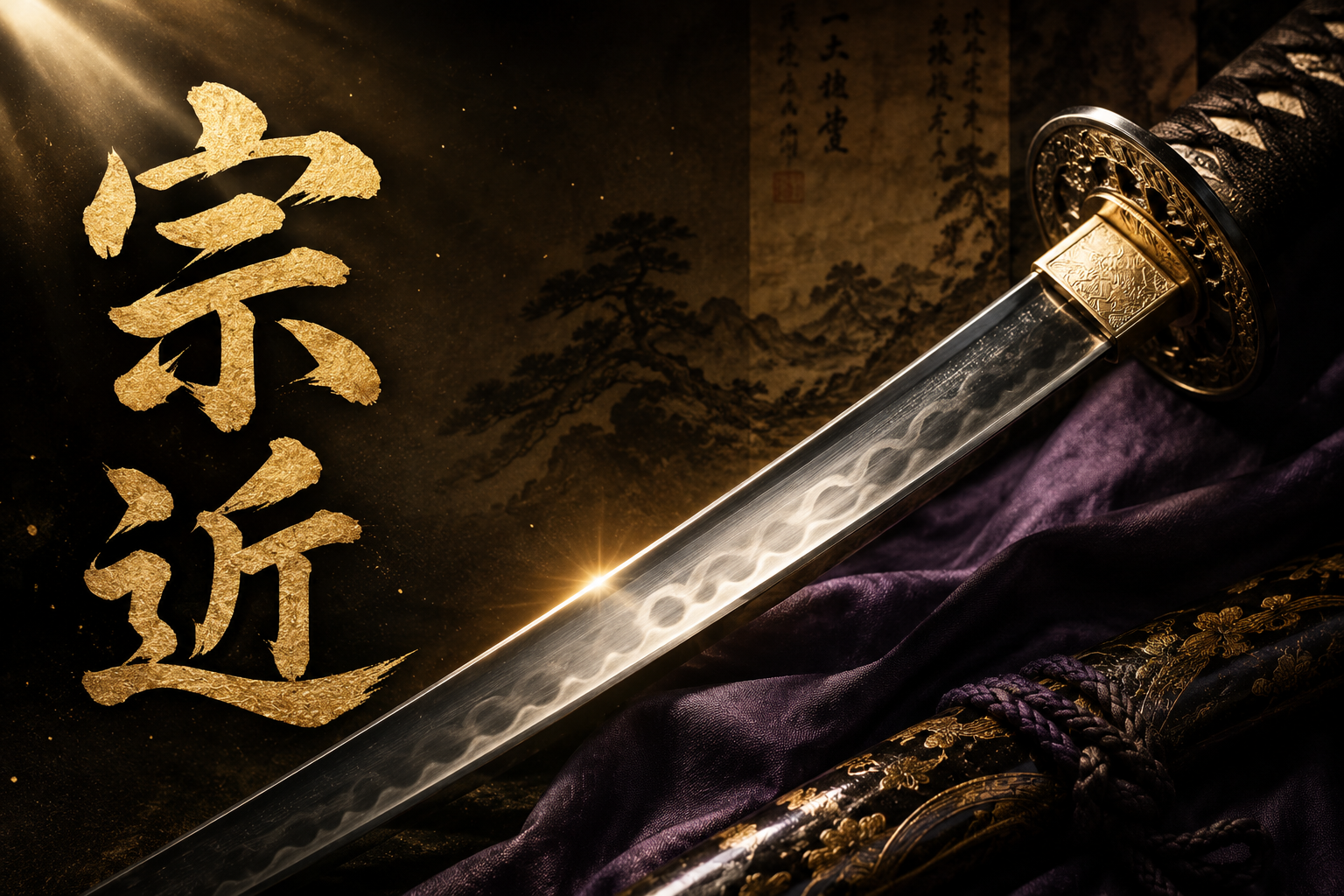
The name derives from the distinctive crescent-shaped patterns visible along the blade. These markings, called uchinoke, appear as delicate half-moon shapes within the temper line (hamon). They are not decorative engravings but rather natural artifacts of the tempering process — a testament to Munechika’s extraordinary control over heat, steel, and clay during the hardening of the edge. The effect is hauntingly beautiful, as though the swordsmith captured moonlight within the metal itself.
One of the Tenka Goken
The Mikazuki Munechika holds a place among the Tenka Goken (天下五剣) — the “Five Swords Under Heaven.” This is a prestigious grouping of five of the finest Japanese swords in existence, each representing the pinnacle of different periods and styles of sword-making. The other four are:
- Dōjigiri Yasutsuna — attributed to Ōhara Yasutsuna
- Onimaru Kunitsuna — attributed to Awataguchi Kunitsuna
- Juzumaru Tsunetsugu — attributed to Aoe Tsunetsugu
- Ōtenta Mitsuyo — attributed to Miike Tenta Mitsuyo
Among this elite group, the Mikazuki Munechika is often singled out as the most beautiful — a distinction that speaks volumes given the company it keeps.
Workmanship and Technical Details
From a technical perspective, the Mikazuki Munechika is a masterclass in Heian-period sword construction. Understanding its physical characteristics helps explain why experts hold it in such high regard.
Shape and Construction
The blade is a tachi with an elegant, sweeping curvature (koshi-zori) that is characteristic of swords from this period. It tapers gracefully toward the tip, with a relatively slender width that gives the sword an almost delicate silhouette. The overall profile exudes refinement — it was clearly designed for a warrior-aristocrat who valued grace as much as lethality.
Hamon and Tempering
The hamon (temper line) is done in a ko-midare style — an irregular, gentle pattern of small waves. What sets it apart are the aforementioned crescent moon shapes scattered along the blade, created through masterful manipulation of the clay coating applied before quenching. This level of control was remarkable for any era, let alone the 10th century.
Jitetsu and Hada
The steel surface (jitetsu) displays a fine grain pattern (hada) that is tight and consistent, indicating exceptionally pure material and meticulous folding technique. The overall appearance of the metal has a warm, luminous quality that sword connoisseurs describe as having nie — bright crystalline particles that catch the light like stars.
Where Can You See the Mikazuki Munechika?
The Mikazuki Munechika is housed in the Tokyo National Museum in Ueno, Tokyo. However, because of its status as a National Treasure and the need for careful conservation, it is not always on public display. The museum rotates its exhibitions, so the sword appears only during certain periods throughout the year.
If you plan a visit specifically to see this legendary blade, it is wise to check the museum’s exhibition schedule in advance. Even if the Mikazuki Munechika is not on display during your visit, the Tokyo National Museum holds an extraordinary collection of Japanese swords spanning centuries of history — any visit is well worth the trip.
The Munechika Legacy in Modern Culture
The Munechika sword has experienced a remarkable resurgence in popular culture, particularly through the wildly popular video game and anime franchise Touken Ranbu. In this series, famous historical swords are personified as attractive warriors, and Mikazuki Munechika is depicted as a calm, elegant, and somewhat enigmatic character — fittingly described with the nickname “Jiji” (old man), a nod to the blade’s immense age.
This cultural phenomenon has introduced a new generation to the world of Japanese swords. Many fans who first encountered the Munechika name through anime or gaming have gone on to develop a genuine passion for nihonto — traditional Japanese swords — and the artistry behind them.
What the Munechika Sword Teaches Us About Japanese Craftsmanship
The enduring fascination with the Munechika sword speaks to something deeper than mere historical curiosity. This blade represents a philosophy of craftsmanship where function and beauty are inseparable, where a weapon can simultaneously be a work of art. The fact that it has survived over a thousand years in remarkable condition is a testament to both the quality of the original forging and the reverence with which subsequent generations have cared for it.
For modern collectors and enthusiasts, the Munechika sword serves as an aspirational benchmark — a reminder of what the Japanese sword tradition is capable of at its absolute peak. While a National Treasure like the Mikazuki Munechika will never be available for private ownership, the tradition it represents lives on in authentic Japanese swords crafted by skilled modern smiths. At Ifu, we offer carefully curated authentic Japanese swords for collectors who share this deep appreciation for the artistry and spirit of nihonto.
Whether you are a seasoned collector or someone whose curiosity was first sparked by a thousand-year-old legend, the Munechika sword remains an endlessly fascinating gateway into the profound world of Japanese blade-making.