The Truth About Suishinshi Masahide: The Smith Who Revived the Katana
In the late Edo period, Japanese swordsmithing was in crisis. Centuries of relative peace under the Tokugawa shogunate had eroded both demand and technique. Blades had become decorative showpieces — ornate, flashy, and often impractical. Then came a swordsmith from Dewa Province who dared to turn back the clock. His name was Suishinshi Masahide, and his radical insistence on returning to the old forging methods of the Kamakura and early Muromachi periods would reshape the entire craft. If you collect or admire nihonto, understanding Masahide isn’t optional — he’s the reason late Edo swords are worth studying at all.
Who Was Suishinshi Masahide?
Born around 1750 in Dewa Province (present-day Yamagata Prefecture), Suishinshi Masahide traveled to Edo (Tokyo) to study swordsmithing and eventually became one of the most consequential smiths of his era. He lived until 1825, a remarkably productive life during which he not only forged exceptional blades but also became a vocal theorist and teacher whose ideas influenced generations of swordsmiths.
Masahide’s given name before taking on his art name was Suzuki Saburōemon. He studied under several masters and absorbed a wide range of techniques, but what set him apart was his willingness to critique the prevailing trends of his own time — and to do so publicly.
The Shinshinto Movement
Masahide is widely regarded as the father of the shinshinto (new-new sword) movement. This wasn’t just a stylistic preference — it was an intellectual revolution. He argued that the shinto (new sword) era smiths of the 17th and 18th centuries had strayed too far from practical blade-making. Their swords prioritized surface beauty — elaborate hamon patterns and showy grain — at the expense of cutting ability and structural integrity.
His solution was to study and revive the methods of the Kamakura period (1185–1333), widely considered the golden age of Japanese swordsmithing. This meant returning to robust constructions, natural-looking hamon, and steel that prioritized function alongside aesthetics.
Masahide’s Philosophy and Writings
What makes Suishinshi Masahide particularly fascinating among Japanese swordsmiths is that he was also a prolific writer. His most important work, Sword Forging Considerations (Tōken Kaji Bikō), laid out his philosophy in detail and became required reading for serious smiths. In it, he classified swords into three categories based on their priorities:
- Swords that cut well — the highest ideal, rooted in the Kamakura tradition
- Swords that are beautiful — the focus of the late shinto period, which he critiqued
- Swords that are both — the aspirational standard he urged his students to pursue
This framework was revolutionary because it reintroduced cutting performance as a central criterion for judging sword quality, something that had been quietly sidelined during peacetime. Masahide didn’t merely theorize — he submitted his own blades to cutting tests (tameshigiri), and several of his surviving works bear cutting test inscriptions (saidan mei) as proof of their effectiveness.
The Tsunahiro Connection
Scholars have noted a significant connection between Masahide and the Tsunahiro lineage of swordsmiths. Early in his career, Masahide studied works by smiths in the Tsunahiro tradition, and elements of their style — particularly their approach to jitetsu (steel grain) and hamon construction — appear in his own blades. This connection is important because it shows that Masahide’s “revival” wasn’t invented from nothing. He was a rigorous student of historical blades, carefully selecting which traditions to resurrect and synthesize into his own method.
Characteristics of Masahide’s Blades
For collectors and enthusiasts, identifying a Suishinshi Masahide blade involves looking for several distinctive features:
Shape and Construction
Masahide’s katana and wakizashi tend to have a robust, purposeful shape. They often feature moderate curvature (sori), a sturdy kissaki (tip), and proportions that echo Kamakura-era tachi. The overall impression is of a blade meant to be used, not merely displayed.
Hamon and Jitetsu
His hamon patterns are typically suguha (straight) or gently undulating notare, reflecting his preference for natural, understated tempering over the flamboyant chōji and gunome patterns popular among his contemporaries. The jitetsu is often a tight itame or ko-mokume with fine ji-nie, giving the steel a dense, substantial appearance.
Signatures and Inscriptions
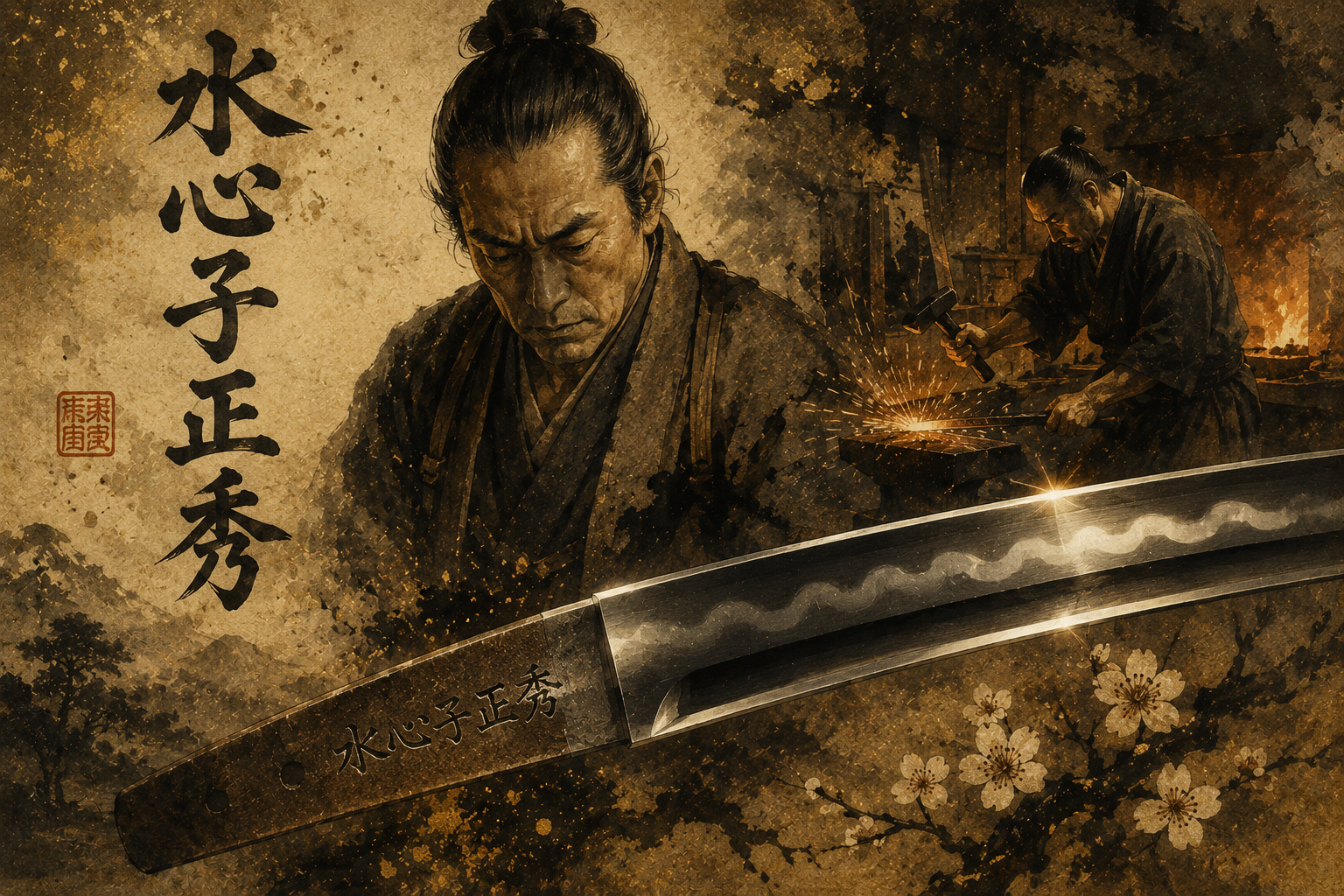
Masahide signed his blades with the characters 水心子正秀 (Suishinshi Masahide). Many of his works also include the date of forging on the tang (nakago). Some carry additional inscriptions noting cutting tests or dedications. His signature evolved over his career, and experienced collectors can roughly date a blade by examining the style of his mei.
Masahide’s Legacy and Students
Perhaps Masahide’s greatest achievement was not any single blade but the movement he inspired. He reportedly trained over 100 students, many of whom became notable smiths in their own right. Among the most famous was Taikei Naotane, who carried Masahide’s revival philosophy even further and became one of the most celebrated shinshinto smiths. Through his students and writings, Masahide’s influence rippled across the final decades of the Edo period and into the Meiji era.
His ideas about balancing beauty with function remain central to how nihonto are evaluated today. When modern polishers and appraisers discuss the qualities that make a blade truly great, they are often echoing arguments that Masahide first articulated over two centuries ago.
Suishinshi Masahide in Popular Culture
Modern audiences may recognize the name Suishinshi Masahide from Touken Ranbu, the popular Japanese multimedia franchise in which historical swords are personified as characters. In this context, Masahide’s sword is depicted as a thoughtful, reform-minded character — a fitting reflection of the real smith’s intellectual legacy. While the game takes considerable creative liberties, it has introduced Masahide’s name to a global audience and sparked genuine interest in the historical figure behind the character.
Collecting Suishinshi Masahide Blades Today
Authentic Masahide blades appear at auction and through specialized dealers, though they command significant prices — particularly examples with NBTHK Tokubetsu Hozon or Jūyō papers. Wakizashi tend to be somewhat more accessible than katana. As with any nihonto purchase, provenance, condition, and proper authentication are essential. Buyers should look for clear mei, sound nakago patina, and ideally an accompanying appraisal from a recognized authority.
For collectors seeking authentic Japanese swords — whether works by renowned shinshinto masters or other exceptional pieces — Ifu offers a carefully curated selection of high-quality nihonto, each chosen for its historical significance, craftsmanship, and condition.
Why Masahide Still Matters
Suishinshi Masahide occupies a rare position in the history of Japanese swords. He was simultaneously a master craftsman, a public intellectual, and a teacher whose influence reshaped an entire tradition. At a time when swordsmithing risked becoming purely decorative, he reminded an entire generation that the soul of the katana lies in its purpose. That message resonates just as strongly today, whether you’re examining a blade in your hands or reading his words for the first time.