The Truth About the Yasutsuna Tachi: Japan’s Most Legendary Sword
In the world of Japanese swords, few blades command as much reverence as the Yasutsuna tachi. Forged over a thousand years ago, this sword sits at the crossroads of myth and masterful craftsmanship — a weapon so extraordinary that it earned its own name by slaying a demon. For collectors, historians, and katana enthusiasts, the Yasutsuna tachi represents the pinnacle of what a Japanese blade can be. But what exactly makes this sword so special, and why does it still captivate the world today?
Who Was Yasutsuna? The Swordsmith Behind the Legend
The name “Yasutsuna” refers to Ōhara Yasutsuna (also written as Ohara Yasutsuna), a swordsmith who is believed to have worked in Hōki Province (modern-day Tottori Prefecture) during the late Heian period, around the 10th to early 11th century. Yasutsuna is widely regarded as one of the earliest identifiable master swordsmiths in Japanese history, and some traditions link him to the legendary Amakuni — the semi-mythical figure often credited with forging the first curved Japanese sword.
What sets Yasutsuna apart from many ancient smiths is that his work survives. While countless early Japanese swords have been lost to war, fire, and the relentless passage of centuries, at least one blade attributed to Yasutsuna endures as a Japanese National Treasure — and it happens to be one of the most famous swords ever made.
The Dōjigiri Yasutsuna: Anatomy of a National Treasure
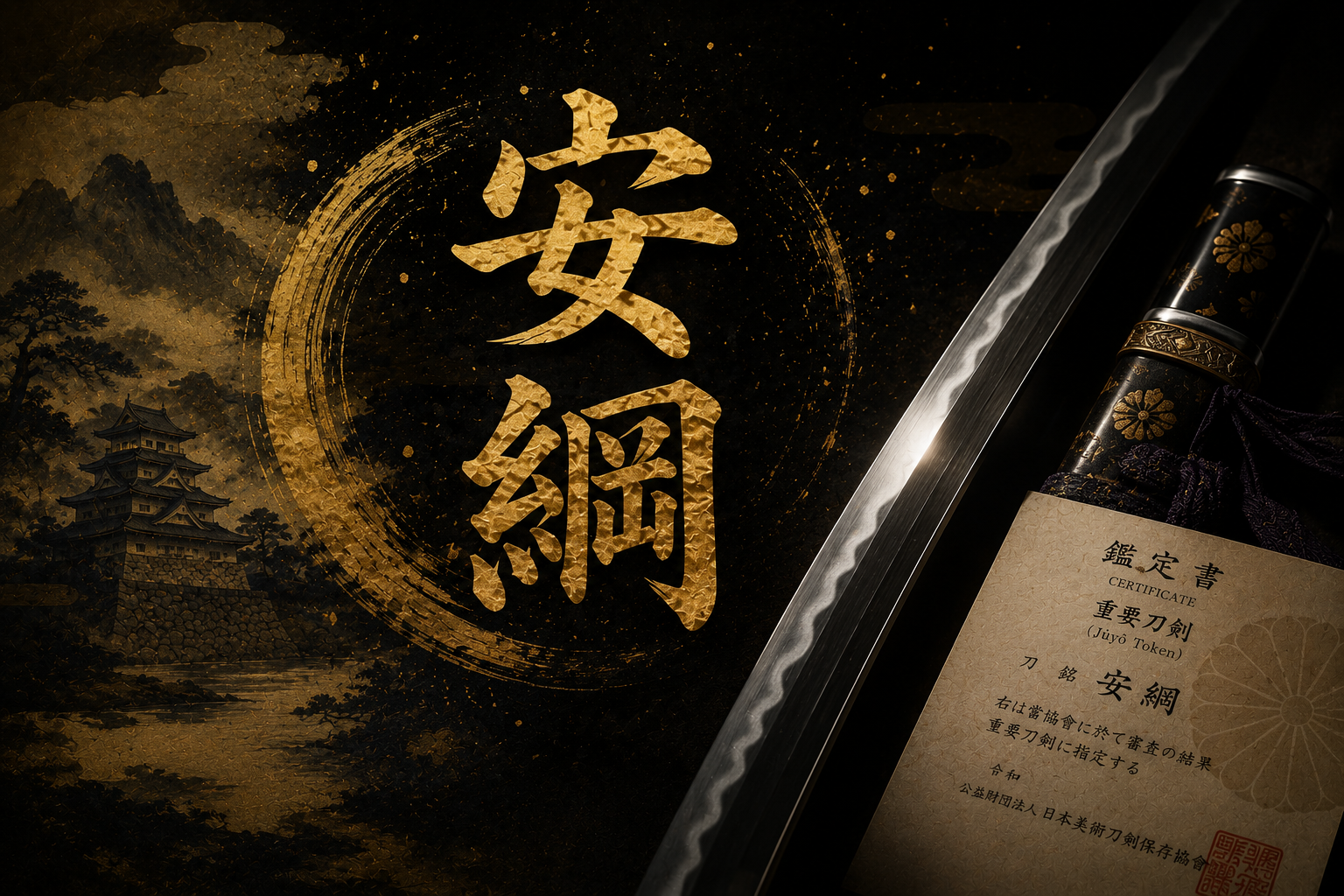
The most celebrated work attributed to Yasutsuna is the Dōjigiri Yasutsuna (童子切安綱), a tachi that has been designated one of Japan’s Tenka Goken — the “Five Swords Under Heaven.” These five blades are considered the supreme masterpieces of Japanese sword-making, and the Dōjigiri holds a place of particular distinction among them.
Physical Characteristics
The Dōjigiri Yasutsuna is a tachi, meaning it was designed to be worn edge-down, suspended from the waist by cords — the standard carry method for mounted warriors before the katana’s edge-up style became dominant. The blade measures approximately 80 centimeters (about 31.5 inches) in length, with a graceful curvature that reflects the elegant aesthetic of Heian-period sword design.
Its jihada (grain pattern) displays a beautiful mix of mokume (wood-grain) and itame (burl) patterns, while the hamon (temper line) features a ko-midare pattern — small, irregular undulations that speak to the sophisticated heat-treatment techniques Yasutsuna employed. The overall impression is one of restrained power: a blade that feels both ancient and utterly purposeful.
Current Preservation
Today, the Dōjigiri Yasutsuna resides in the Tokyo National Museum, where it is carefully preserved and occasionally displayed. It was designated a National Treasure of Japan, the highest cultural protection status a Japanese artifact can receive. For sword enthusiasts, seeing it in person is a profound experience — a direct encounter with over a millennium of history.
The Legend: How a Tachi Earned Its Demon-Slaying Name
The prefix “Dōjigiri” literally means “Shuten-dōji cutter,” and it ties the sword to one of Japan’s most dramatic legends. According to the tale, the fearsome oni (demon) Shuten-dōji terrorized the region around Mount Ōe, kidnapping people from Kyoto and terrorizing the capital. The warrior Minamoto no Yorimitsu (also known as Raikō), one of the most celebrated heroes of the Heian period, was tasked with eliminating this threat.
Yorimitsu and his band of retainers — the famous Shitennō (Four Heavenly Kings) — infiltrated Shuten-dōji’s lair disguised as mountain priests. After a cunning stratagem involving poisoned sake, Yorimitsu used his tachi to behead the demon in a single devastating stroke. That sword, according to tradition, was the blade forged by Yasutsuna. From that day forward, it bore the name Dōjigiri — the demon cutter.
Whether one takes this legend at face value or interprets it as an allegory for suppressing banditry in the mountainous frontier, the story speaks to the Japanese cultural belief that a great sword possesses its own spirit and destiny. The blade was not merely a tool; it was a partner in heroism.
Understanding the Tachi: The Ancestor of the Katana
To fully appreciate the Yasutsuna tachi, it helps to understand the tachi as a sword type. The tachi predates the katana and was the dominant long sword of Japan from roughly the Heian period through the early Muromachi period (approximately the 10th through 14th centuries).
Key Differences Between Tachi and Katana
- Carry method: The tachi was worn suspended edge-down from the obi (sash), while the katana is thrust through the obi edge-up.
- Curvature: Tachi typically feature a deeper curvature (koshi-zori), concentrated near the base of the blade, optimized for cutting from horseback.
- Length: Tachi blades tend to be slightly longer than standard katana, reflecting their use as cavalry weapons.
- Signature placement: The smith’s signature (mei) on a tachi is inscribed on the opposite side of the tang compared to a katana, so it faces outward when the sword is worn in its intended manner.
The tachi’s elegant profile and sweeping curvature gave it a distinct beauty that many collectors find even more captivating than the katana. The Yasutsuna tachi exemplifies these qualities at their finest — a blade designed for both battlefield effectiveness and aesthetic perfection.
The Yasutsuna Legacy: Influence on Japanese Sword-Making
Yasutsuna’s influence extends far beyond a single legendary blade. As one of the earliest documented smiths of the Hōki tradition, he helped establish forging techniques and aesthetic principles that would ripple through Japanese sword history for centuries. The Hōki school’s emphasis on robust construction and distinctive grain patterns can be traced, at least in spirit, back to Yasutsuna’s era.
His work also demonstrates that even in the earliest periods of Japanese sword-making, smiths were achieving a level of technical sophistication that modern metallurgists still study with admiration. The combination of differential hardening, precise carbon control, and artistic sensibility visible in the Dōjigiri reveals that Yasutsuna was not merely a craftsman — he was an artist working in steel.
Why the Yasutsuna Tachi Still Matters Today
For modern collectors and martial arts practitioners, the Yasutsuna tachi serves as a powerful reminder of what a Japanese sword represents at its highest level: the fusion of function, beauty, and cultural meaning. It is not just a weapon. It is a statement about the relationship between a maker, a warrior, and the world they inhabited.
If the story of the Yasutsuna tachi inspires you to explore the world of authentic Japanese swords, Ifu offers a curated selection of high-quality, genuine katana and tachi for collectors who demand the real thing — blades that carry forward the same traditions Yasutsuna helped define over a thousand years ago.
Whether you are a seasoned collector or just beginning to discover the depth and beauty of Japanese swords, the Yasutsuna tachi stands as an enduring testament to the idea that the greatest blades are not just forged — they are born, carrying stories that outlast the steel itself.