Yukimitsu Sword: The Brilliant Legacy of Sōshū’s Master Bladesmith
Among the pantheon of legendary Japanese swordsmiths, few names carry as much reverence as Yukimitsu (行光). A pivotal figure in the Sōshū tradition of swordmaking, Yukimitsu bridged the gap between his master — the great Masamune — and the generations of smiths who would follow. His blades are considered some of the finest ever forged, with several designated as National Treasures and Important Cultural Properties of Japan. For collectors and enthusiasts of nihontō, understanding Yukimitsu is essential to appreciating the art and craft of the Japanese sword at its absolute zenith.
Who Was Yukimitsu? A Brief Biography
Yukimitsu, formally known as Sōshū Yukimitsu (相州行光), was active during the late Kamakura to early Nanbokuchō period, roughly the late 13th to early 14th century. He worked in Kamakura in Sagami Province (present-day Kanagawa Prefecture), which was the political and military heart of Japan under the Kamakura shogunate. This region — known as Sōshū — became the epicenter of an extraordinary revolution in sword-forging technology.
Historical records and sword scholarship generally identify Yukimitsu as either the son or a close disciple of Masamune, arguably the most famous swordsmith in Japanese history. While the exact nature of their relationship has been debated by scholars for centuries, there is no dispute about the quality of Yukimitsu’s work. His surviving blades demonstrate a mastery of steel that places him firmly in the highest echelon of the craft.
The Sōshū Tradition and Yukimitsu’s Place Within It
To fully appreciate the Yukimitsu sword, one must understand the Sōshū school (相州伝) in which he worked. The Sōshū tradition represents one of the Five Traditions (Gokaden) of Japanese swordmaking, and it is widely regarded as the most technically advanced. The tradition was founded and refined by a lineage of extraordinary smiths: Shintōgo Kunimitsu, Masamune, and Yukimitsu himself, among others.
The hallmarks of Sōshū-den blades include:
- Nie-based hamon: The hardening pattern is formed predominantly by large, visible martensite crystals (nie) rather than the finer nioi particles favored by other traditions.
- Complex jihada: The grain pattern of the steel often displays intricate combinations of itame and mokume, sometimes interspersed with brilliant activities such as chikei (dark lines in the ji) and kinsuji (golden lines in the ha).
- Dynamic and dramatic aesthetics: Sōshū blades tend to exhibit bold, sweeping tempering patterns with deep ashi (legs of nioi extending into the ha) and yō (isolated areas of activity).
Yukimitsu inherited and mastered these characteristics, but he also brought his own distinctive sensibility to the work. His blades are often noted for a certain refinement and subtlety that sets them apart even within the Sōshū tradition.
Characteristics of Yukimitsu’s Work Style
Blade Forms (Sugata)
Yukimitsu is perhaps best known for his tantō (short swords) and ko-wakizashi, though katana attributed to him also exist. His tantō are frequently in the standard Kamakura proportions — moderate length, slight uchizori (inward curvature), and a dignified, understated shape. Some of his works show the wider, more imposing proportions that foreshadow the grand blades of the Nanbokuchō era.
Tempering Patterns (Hamon)
Yukimitsu’s hamon often features a notare-based pattern (gently undulating waves) mixed with gunome (clove-shaped peaks) and elements of midare (irregular patterns). The boundary of the hamon is richly populated with nie, and the transitions between hardened and unhardened steel are often breathtakingly complex. In the finest examples, the hamon seems almost alive — shimmering with activity when the blade is turned in light.
Steel Texture (Jihada)
The jihada of a Yukimitsu blade is typically a tight itame (wood-grain pattern) that is well-forged and dense. What distinguishes it is the abundance of ji-nie (nie particles within the body of the blade) and the frequent appearance of chikei. These features give the steel a luminous, almost celestial quality that collectors and connoisseurs find deeply compelling.
Signatures (Mei)
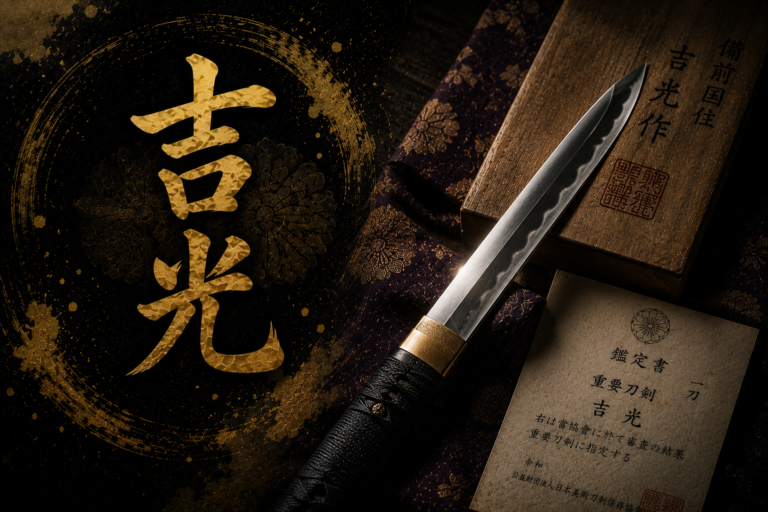
Yukimitsu signed his blades with the two-character inscription 行光 (Yukimitsu). Authenticated signed works are exceedingly rare and command enormous respect in the nihontō world. Many blades attributed to Yukimitsu bear the prefix den (伝), meaning “attributed to,” as their authorship is based on expert appraisal of workmanship rather than a surviving signature.
Important Works and Designations
Several Yukimitsu blades have been designated as National Treasures (Kokuhō) and Important Cultural Properties (Jūyō Bunkazai) by the Japanese government — a testament to their historical and artistic significance. Among the most celebrated is a signed tantō held in national collections, recognized for its impeccable forging and pristine condition.
Beyond governmental designations, the Nihon Bijutsu Tōken Hozon Kyōkai (NBTHK) — Japan’s foremost sword-preservation society — has classified numerous Yukimitsu works at the Jūyō Tōken and Tokubetsu Jūyō Tōken levels, their highest appraisal categories. Blades that achieve these rankings are recognized as works of supreme artistic merit.
Yukimitsu’s Historical Provenance and Famous Owners
Throughout Japanese history, Yukimitsu swords were treasured by powerful warlords and feudal lords. During the Sengoku period, owning a blade by a Sōshū master like Yukimitsu was a statement of status, taste, and martial prestige. Oda Nobunaga, the great unifier of Japan, was known to have possessed and gifted exceptional swords from the Sōshū tradition, and blades attributed to Yukimitsu and his contemporaries circulated among the highest echelons of the samurai elite.
The provenance of a Yukimitsu sword — the chain of ownership from its creation to the present day — adds immense value and historical depth. Some blades can be traced through centuries of records, moving from daimyō collections to modern-day museums and private collectors.
Yukimitsu’s Lineage and Influence
Yukimitsu’s influence extended far beyond his own lifetime. The Sōshū tradition he helped refine would dominate Japanese swordmaking for generations. Later smiths such as Hiromitsu and Akihiro continued and evolved the aesthetic principles that Yukimitsu and Masamune established. Even during the Shintō and Shin-Shintō periods — centuries after his death — swordsmiths looked back to the Sōshū masters as the ultimate standard of excellence.
During the Bakumatsu period in the 19th century, smiths of the Shin-Shintō movement explicitly sought to revive the glory of Kamakura- and Nanbokuchō-era swordmaking, and Yukimitsu’s work was among the exemplars they studied. His legacy, therefore, is not merely historical — it is a living tradition that continues to inform and inspire.
Collecting Yukimitsu Swords Today
Authentic Yukimitsu blades are extraordinarily rare on the open market. When they do appear, they are highly sought after by serious collectors worldwide and often carry price tags reflecting their exceptional rarity and cultural importance. Even blades classified as den Yukimitsu — attributed through expert analysis rather than a surviving signature — are considered major acquisitions.
For collectors seeking to own a piece of this remarkable tradition, it is essential to work with knowledgeable and reputable dealers who can verify authenticity, provenance, and condition. At Ifu, we offer a curated selection of high-quality authentic Japanese swords, each carefully vetted for collectors who demand excellence and integrity in every blade they acquire.
Why the Yukimitsu Sword Endures
The enduring fascination with Yukimitsu’s work comes down to something elemental: the perfect marriage of function and beauty. These are not mere weapons — they are masterworks of metallurgy and art, created at a moment in history when the swordsmith’s craft reached a pinnacle that has never been surpassed. To hold a Yukimitsu blade, or even to study one behind museum glass, is to stand in the presence of genius forged in steel.
For anyone passionate about Japanese swords, Yukimitsu represents an essential chapter in the story of the nihontō — a chapter of innovation, artistry, and enduring brilliance.