Tegai Kanenaga: What Collectors Must Know
Among the storied smiths of Japan’s Yamato tradition, the name Kanenaga of the Tegai school occupies a place of quiet reverence. These blades, forged in the ancient capital of Nara, represent some of the most refined and spiritually significant works in the entire history of Japanese swordmaking. Yet for many Western collectors, Tegai Kanenaga remains an elusive subject — shrouded in scholarly debate, often found as unsigned blades attributed through painstaking expert analysis. This guide will illuminate the history, characteristics, and collecting considerations surrounding these remarkable swords.
The Tegai School: Nara’s Finest Swordsmiths
The Tegai school (手搔派) was one of the five major schools within the broader Yamato tradition (Yamato Gokaden), which also included Senjuin, Taima, Shikkake, and Hosho. Based near the Tegai Gate of Tōdai-ji temple in Nara, these smiths worked closely with the powerful religious institutions that dominated the ancient capital. Their blades were originally forged to arm the warrior monks (sōhei) who defended temple interests during the turbulent late Heian and Kamakura periods.
What distinguishes Tegai work from other Yamato schools is a particular elegance in execution. While all Yamato smiths favored straight-grained (masame-hada) steel and subdued tempering patterns, Tegai smiths achieved an exceptional level of refinement in their forging, producing blades with a dignified, almost austere beauty that reflected their sacred surroundings.
Who Was Kanenaga?
The name Kanenaga (包永) is the most celebrated within the Tegai lineage. The founder, often referred to as Shodai (first generation) Kanenaga, is generally dated to the mid-Kamakura period, roughly the late 13th century. He is considered the progenitor of the school’s most productive and skilled line of smiths. Subsequent generations continued to use the Kanenaga name, making precise attribution a matter of careful metallurgical and stylistic analysis.
The first-generation Kanenaga is ranked among the superior smiths of the Kamakura era. His work is characterized by a confident hand, producing blades that balance martial functionality with a restrained aesthetic sensibility. Blades attributed to the earliest generations are exceptionally rare and command significant attention when they appear on the market or in certification submissions.
Generations and Lineage
The Kanenaga name persisted across multiple generations, extending from the Kamakura period well into the Muromachi era. Key points about the lineage include:
- Shodai Kanenaga (first generation): Active during the mid-to-late Kamakura period. Regarded as the school’s defining master.
- Nidai Kanenaga (second generation): Active during the late Kamakura to early Nanbokuchō period. His work closely follows the founder’s style but sometimes shows slightly broader blade geometry reflecting the era’s evolving taste.
- Later generations: The name continued through the Muromachi period, with varying degrees of skill. Later Kanenaga smiths are generally considered competent but less individually distinguished than their Kamakura-era ancestors.
Related smiths within the Tegai school — including Kanekiyo, Kanetoshi, and Kanehisa — shared the characteristic “Kane” (包) kanji prefix, signaling their membership in this tight-knit tradition of temple-associated swordsmiths.
Identifying Characteristics of Tegai Kanenaga Blades
Recognizing a Tegai Kanenaga blade requires an understanding of both Yamato-tradition hallmarks and the specific traits that distinguish this school. Here are the features that experts look for:
Jihada (Steel Surface)
The jigane of Kanenaga blades typically displays a prominent masame-hada — a straight grain pattern that runs parallel to the blade’s length. This is the defining characteristic of Yamato-tradition forging. In the finest examples, the masame is tight and consistent, sometimes interspersed with traces of mokume (burl-grain) near the cutting edge. The steel itself often has a warm, slightly dark tone with fine ji-nie (crystalline particles) scattered across the surface.
Hamon (Temper Line)
Tegai Kanenaga blades typically exhibit a suguha (straight) hamon or a gently undulating suguha with subtle variations. The temper line is rendered in nie-deki — composed of visible individual crystalline particles rather than the softer, cloud-like nioi favored by Bizen smiths. This gives the hamon a luminous, granular texture that reveals new details under different lighting conditions. Fine sunagashi (sweeping sand-like lines) and kinsuji (gold lines) may appear within the tempered area, adding further depth.
Sugata (Shape)
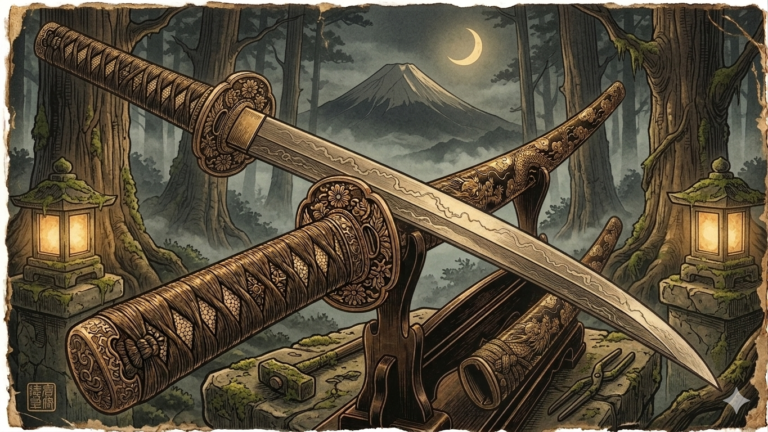
Kamakura-period Kanenaga blades typically display an elegant tachi shape with moderate curvature concentrated near the base (koshi-zori), a compact kissaki (tip), and a modest width. Nanbokuchō-era works may show broader proportions. The nakago (tang) shape, when original, provides crucial information for generation attribution — early Tegai tangs tend to be relatively narrow with a distinctive finishing style.
Signatures and Mumei Blades
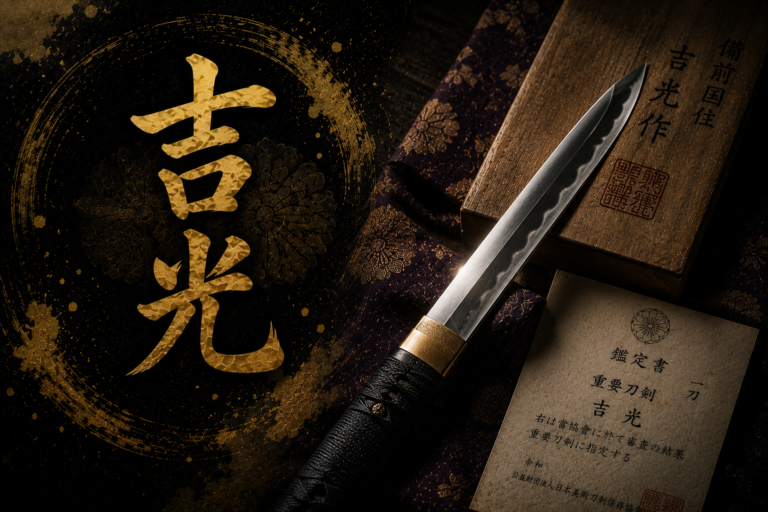
A significant number of surviving Tegai Kanenaga blades are mumei (unsigned), either because the tang was shortened over centuries of remounting or because the original smith did not sign the blade. Attribution in these cases relies on the judgment of expert appraisers, often documented through certifications from organizations like the NBTHK (Nihon Bijutsu Tōken Hozon Kyōkai). Papers reading “Den Tegai Kanenaga” indicate an attribution to the style of Kanenaga without absolute certainty — a common and entirely respectable designation for blades of this age.
Certification and Appraisal
For collectors, NBTHK certification papers are essential when evaluating any Tegai Kanenaga blade. The most commonly encountered levels include:
- Hozon Tōken: Worthy of preservation — confirms the blade as a genuine Japanese sword of historical merit.
- Tokubetsu Hozon: Especially worthy of preservation — indicates higher quality and condition.
- Jūyō Tōken: Important sword — reserved for works of exceptional quality. A Tegai Kanenaga with Jūyō certification is a significant find.
Blades attributed to the first or second generation Kanenaga at the Jūyō level represent some of the most desirable Yamato-tradition swords available to collectors. These certifications provide critical confidence in an area where forgeries and misattributions have existed for centuries.
Collecting Tegai Kanenaga: Practical Considerations
If you are considering adding a Tegai Kanenaga blade to your collection, keep several factors in mind. First, condition matters enormously — these blades are often 700 or more years old, and the degree to which the original jihada and hamon have been preserved through centuries of polishing directly affects both scholarly and monetary value. Second, provenance and documentation should be thoroughly vetted. A blade with a clear history of NBTHK certification, reputable prior ownership, or published references carries far greater confidence.
Finally, seek guidance from knowledgeable dealers who specialize in authentic nihontō. Stores like Ifu offer carefully curated selections of genuine Japanese swords, providing collectors with the expertise and transparency needed to make informed acquisitions.
Why Tegai Kanenaga Matters Today
In an era when many collectors gravitate toward the flamboyant works of Bizen or Sōshū traditions, Tegai Kanenaga blades offer something profoundly different — a quiet authority rooted in spiritual discipline and an aesthetic that values subtlety over spectacle. Owning one is to hold a direct connection to the temple forges of medieval Nara, where steel was shaped not merely as a weapon but as an expression of devotion. For the serious collector, few names carry more weight in fewer syllables.