Ikkanshi Tadatsuna: What Every Collector Should Know
Among the legendary swordsmiths of Japan’s Shinto period, few names command as much reverence as Ikkanshi Tadatsuna. His blades represent a pinnacle of craftsmanship during the Edo era, blending classical Awataguchi aesthetics with technical innovations that still captivate collectors centuries later. Yet for many enthusiasts outside Japan, the story of this master smith remains fragmented and misunderstood. This article explores the life, lineage, and lasting legacy of Ikkanshi Tadatsuna — and why his work continues to set the standard for Shinto-era swords.
Who Was Ikkanshi Tadatsuna?
Ikkanshi Tadatsuna is the name most commonly associated with the second-generation Awataguchi Omi no Kami Tadatsuna, a swordsmith who worked in Settsu Province (modern-day Osaka) during the middle Edo period, roughly the late 17th to early 18th century. He is widely regarded as the more accomplished of the Tadatsuna lineage, and the title “Ikkanshi” (一竿子) — a poetic art name meaning “one rod master” — has become almost inseparable from his identity.
The first-generation Tadatsuna established the family name and received the prestigious title Omi no Kami (近江守), a provincial honorary title granted to skilled artisans. But it was his successor, the second generation, who elevated the school’s reputation to extraordinary heights. Working during a time when Osaka was one of Japan’s premier sword-making centers, Ikkanshi Tadatsuna stood alongside giants like Inoue Shinkai and Tanba no Kami Yoshimichi as one of the finest smiths of the Osaka Shinto tradition.
The Tadatsuna School and Its Place in the Shinto Era
To understand Ikkanshi Tadatsuna’s significance, it helps to place him within the broader context of the Shinto sword-making period. The Shinto era (roughly 1596–1781) saw a dramatic shift in Japanese sword production. As the country entered a prolonged period of peace under the Tokugawa shogunate, swordsmiths refined their techniques and often drew inspiration from the great Koto-era masters while developing distinctly new styles.
Osaka as a Sword-Making Capital
Osaka emerged as one of the seven major sword-making regions during the Shinto period. The city’s thriving economy, merchant culture, and proximity to political power in Kyoto made it a magnet for talented artisans. The Osaka tradition is known for producing swords of exceptional beauty, with bright and vivid hamon (temper lines) and refined jigane (steel surface). Ikkanshi Tadatsuna’s work exemplifies this tradition at its finest.
The Awataguchi Connection
The Tadatsuna school claimed descent from the illustrious Awataguchi school of Kyoto, one of the most revered sword-making lineages of the Kamakura period. By invoking the Awataguchi name in their signatures — typically reading Awataguchi Omi no Kami Tadatsuna — the smiths of this school positioned themselves as inheritors of a centuries-old tradition. While the direct lineage is a matter of scholarly debate, the aspiration itself speaks to the deep reverence that Shinto-era smiths held for their Koto predecessors.
Characteristics of Ikkanshi Tadatsuna Blades
Collectors prize Ikkanshi Tadatsuna’s swords for several distinctive qualities that set them apart from the work of contemporaries.
Sugata (Shape)
His katana and wakizashi typically display an elegant sugata with a moderate curve (sori) and a well-proportioned width. Many of his longer blades reflect the graceful aesthetic ideals of the Osaka school, balanced between martial functionality and visual refinement. The kissaki (tip) is often of medium length, contributing to an overall sense of harmony.
Jigane (Steel)
The forging pattern on Ikkanshi Tadatsuna blades generally exhibits a tight and refined ko-itame hada (small wood-grain pattern), sometimes with mokume elements. The steel surface has a characteristic brightness and clarity associated with Osaka work, often described as having a luminous, almost jewel-like quality.
Hamon (Temper Line)
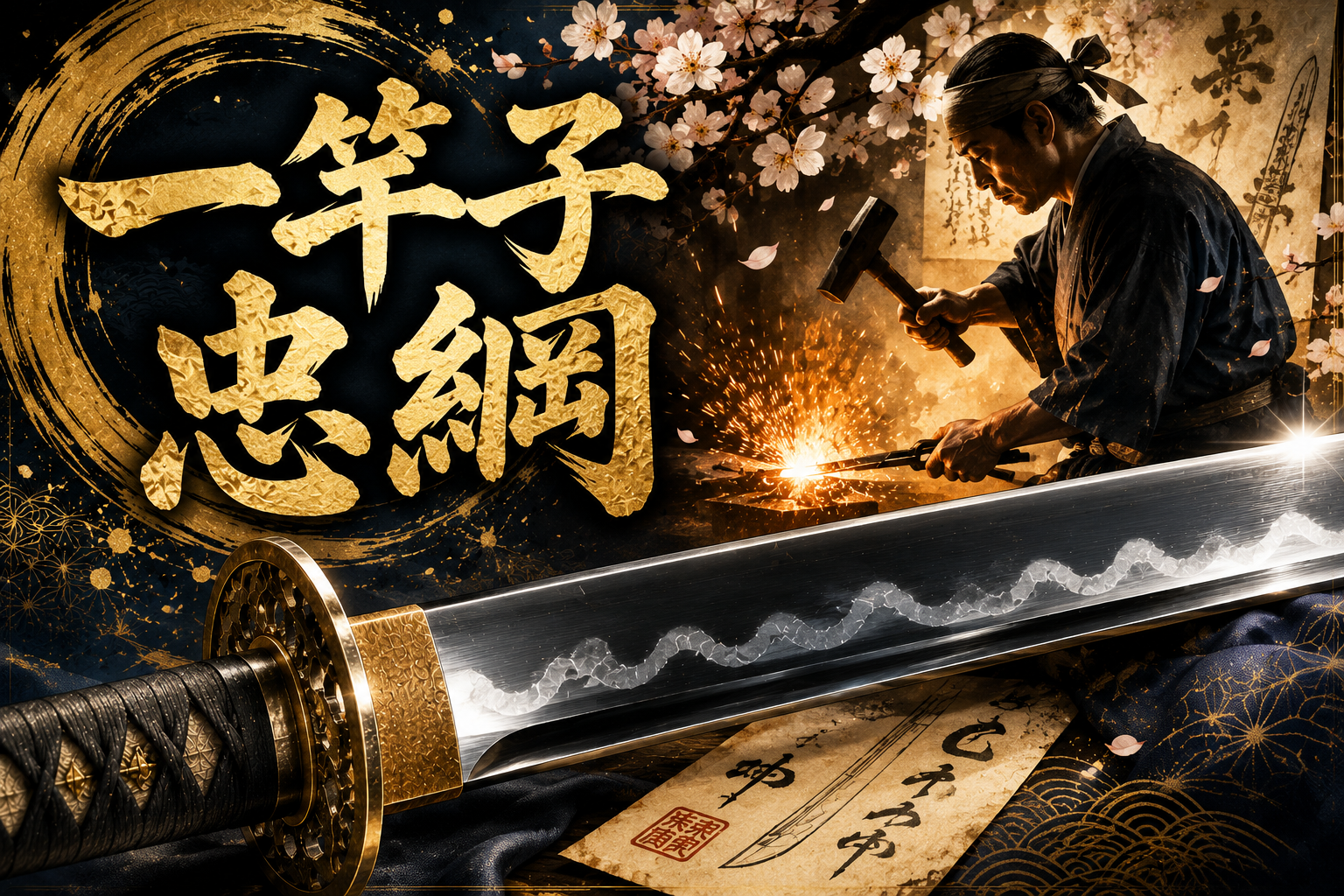
Perhaps the most celebrated feature of his blades is the hamon. Ikkanshi Tadatsuna was a master of the toran-ba (billowing wave) pattern — a bold, undulating temper line that resembles crashing waves. This dramatic style became a signature of his work. He also produced gunome-midare and choji-midare patterns with exquisite nioi and nie activity, demonstrating remarkable control over the hardening process.
Horimono (Carvings)
Some of his blades feature horimono carvings, and his signatures sometimes include the notation hori-dōsaku, indicating that the carvings were done by his own hand rather than by a specialist. This is notable because many smiths outsourced carving work, and a smith’s ability to produce his own horimono was considered a mark of exceptional versatility.
Mei (Signature) and Authentication
Ikkanshi Tadatsuna’s standard signature reads 粟田口近江守忠綱 (Awataguchi Omi no Kami Tadatsuna), often accompanied by the art name 一竿子 (Ikkanshi). Dated examples from his working period — such as blades inscribed with dates in the Hōei era (1704–1711) — are particularly valued by collectors as they provide precise historical context.
As with all highly sought-after swordsmiths, forgeries and later copies exist. Prospective buyers should always seek blades with NBTHK (Nihon Bijutsu Token Hozon Kyokai) certification — ideally Tokubetsu Hozon or Juyo Token papers — to confirm authenticity. The tang (nakago) condition, patina, file marks (yasurime), and character style all play critical roles in authentication.
Legacy and Collectibility
Ikkanshi Tadatsuna is consistently ranked among the top Osaka Shinto smiths. His work has been designated as Juyo Token (Important Sword) on multiple occasions, and fine examples occasionally appear at the highest levels of Japanese sword appraisal. For collectors, acquiring an authentic Ikkanshi Tadatsuna blade represents ownership of a piece of Japanese art history — one that bridges the classical Awataguchi ideal with the vibrant Osaka tradition.
Market values for his blades reflect this prestige. While not quite reaching the astronomical prices of the greatest Koto-era works, high-quality Ikkanshi Tadatsuna swords command significant sums, particularly those with distinguished provenance, excellent condition, and strong certification.
Where to Find Authentic Ikkanshi Tadatsuna Swords
For collectors seeking genuine Japanese swords — whether a masterwork by Ikkanshi Tadatsuna or other notable smiths — sourcing from reputable dealers is essential. At Ifu, we offer a carefully curated selection of authentic Japanese swords, each verified for quality and provenance, ensuring collectors can purchase with confidence.
Whether you are a seasoned collector or beginning your journey into the world of nihonto, understanding smiths like Ikkanshi Tadatsuna deepens your appreciation for the art, history, and soul forged into every blade. His work stands as enduring proof that the swordsmiths of the Shinto era were not merely craftsmen — they were artists of the highest order.