How to Display Nihonto at Home Without Ruining Them
You finally own an authentic Japanese sword. Maybe it’s a family heirloom, maybe it’s your first serious purchase after years of admiration. Either way, the blade deserves more than a closet shelf. But displaying nihonto at home isn’t just about aesthetics — it’s about preservation. Get it wrong, and you could damage a piece of living history that has survived centuries. Get it right, and your sword becomes the centerpiece of a room while staying in pristine condition for generations to come.
Why the Way You Display a Nihonto Actually Matters
Nihonto are not decorative replicas. They are hand-forged from tamahagane steel, finished with organic lacquer, wrapped in silk or cotton, and fitted with components made from copper alloys that react to their environment. Every element — the blade, the saya (scabbard), the tsuka (handle), and the fittings — responds to humidity, temperature, light, and physical contact.
A poorly chosen display method can cause rust spots on the blade, cracks in the saya lacquer, loosening of the mekugi (retaining pins), and tarnishing of the tsuba and other fittings. The stakes are real, and the damage is often irreversible. Your display setup is, in practice, a long-term storage decision.
Horizontal Stands (Katanakake): The Classic Starting Point
The most common and accessible way to display a nihonto at home is a horizontal stand, known as a katanakake (刀掛け). These stands hold the sword horizontally across two or more resting arms and are available in single-tier or multi-tier configurations for collectors with more than one blade.
What to Look for in a Quality Stand
- Material: Choose hardwood stands with a smooth, lacquered or waxed finish. Avoid raw, untreated softwoods that may off-gas acids harmful to metal over time.
- Padding: The resting arms should be cushioned with felt or soft cloth to prevent scratches on the saya.
- Stability: A good stand has a low center of gravity and a wide base. A nihonto in full koshirae can weigh over a kilogram — tipping is not an option.
- Size: Make sure the stand accommodates the full length of your sword. A katana that overhangs the edges looks awkward and risks being bumped.
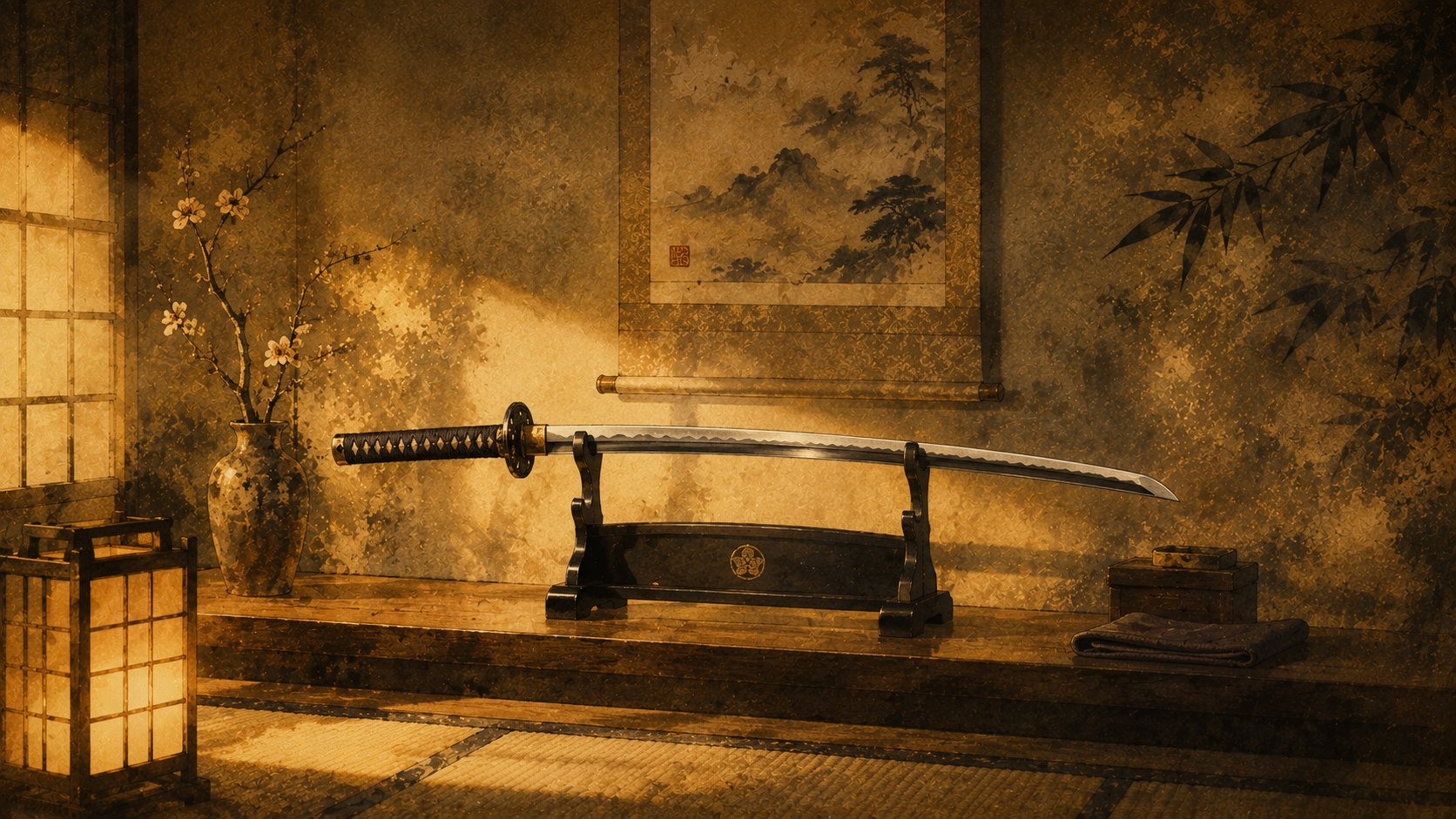
Horizontal stands work beautifully on shelves, desks, and within tokonoma alcoves. They’re also the most traditional method of display in Japanese homes.
Wall Mounts: The Dojo-Inspired Approach
Wall-mounted displays save floor and surface space while creating a dramatic visual impact. They’re inspired by the way swords were displayed in training halls and samurai residences.
Structural Considerations Before You Drill
Before mounting anything to your wall, you need to verify the wall can handle it. A mounted nihonto in its koshirae typically weighs between 1 and 1.5 kilograms, but the mount itself adds weight, and you need to account for leverage. Always anchor into wall studs or use appropriate masonry fixings. Drywall anchors alone are not sufficient — a falling nihonto is a safety hazard and a collector’s nightmare.
Choose mounts with padded hooks or cradles, and ensure the sword sits securely without any wobble. Position the mount away from doorways, high-traffic areas, and anywhere it could be accidentally knocked.
Display Cases: When Preservation Is the Priority
For collectors in humid climates or those with especially valuable blades, an enclosed display case offers the best protection. A good case shields the sword from dust, accidental contact, and rapid environmental changes.
Choosing the Right Case
- Glass-front cabinets: These offer visibility while keeping the sword enclosed. Look for cases with UV-filtering glass to prevent light damage to lacquer and wrappings.
- Museum-style vitrines: More expensive, but they allow full 360-degree viewing and often come with built-in lighting.
- Custom-built cases: The ideal option for serious collectors. You can specify dimensions, interior padding, and even integrate climate control features.
If you go with a sealed or semi-sealed case, consider placing silica gel packets or a small dehumidifier element inside to regulate moisture. Stagnant, humid air inside a closed case is one of the fastest paths to rust.
The Tokonoma: A Japanese Tradition Worth Borrowing
In traditional Japanese architecture, the tokonoma (床の間) is a recessed alcove used to display art, flowers, and prized objects. It is considered the most honored space in a room, and historically, it was where a family’s finest sword would be presented.
You don’t need a Japanese-style home to create a tokonoma-inspired display. A dedicated shelf or alcove, kept minimal and clean, with a simple katanakake and perhaps a scroll or seasonal flower arrangement, captures the spirit beautifully. The key principle is restraint — the sword should be the focal point, not competing with clutter.
Edge Up or Edge Down? The Orientation Debate
This question comes up constantly, and the answer depends on the sword’s mounting.
- Katana and wakizashi in koshirae: Display with the cutting edge facing up (ha, or edge, pointing toward the ceiling). This is the traditional peacetime display orientation, mimicking how the sword sits when worn edge-up at the waist.
- Tachi in tachi-style koshirae: Display with the cutting edge facing down, as tachi were worn suspended edge-down from the belt.
Displaying edge-up also has a practical benefit: it reduces prolonged contact between the blade’s cutting edge and the interior of the saya, helping to prevent wear on both surfaces over time.
Humidity, Temperature, and the Enemies of Steel
The single greatest threat to a nihonto on display is uncontrolled humidity. The ideal range is between 40% and 55% relative humidity. Below 35%, you risk cracking the saya lacquer and drying out the tsuka wrapping. Above 60%, corrosion becomes a serious concern.
Common Mistakes That Cause Damage
- Placing the sword near exterior walls: These walls experience temperature swings and condensation, especially in older homes.
- Displaying near windows: Direct sunlight heats the blade unevenly and degrades organic materials like lacquer, silk, and ray skin.
- Kitchens and bathrooms nearby: Steam and cooking vapors introduce moisture and acidic particles to the air.
- Neglecting regular oiling: Even a well-displayed nihonto needs its blade wiped and re-oiled with choji oil every few months, more frequently in challenging climates.
Invest in a simple digital hygrometer for the room where your sword is displayed. It’s a small expense that can save you from catastrophic damage.
Making Your Display Personal and Purposeful
Ultimately, how you display your nihonto should reflect both respect for the sword and your personal connection to it. Some collectors prefer a single blade in a minimalist setting; others build dedicated rooms to house growing collections. There’s no single correct approach, only principles — proper orientation, stable climate, secure mounting, and regular maintenance.
If you’re building or expanding a collection and looking for authentic, high-quality Japanese swords, Ifu offers a carefully curated selection of genuine nihonto suited for collectors who value both artistry and provenance.
Key Takeaways
- Your display method is a preservation decision — choose carefully based on your climate and living space.
- Horizontal stands are the most versatile option; wall mounts and display cases offer alternatives for different needs.
- Always display katana edge-up and tachi edge-down.
- Maintain 40–55% relative humidity and avoid direct sunlight, exterior walls, and steam sources.
- Oil the blade regularly, regardless of how well-protected your display setup is.
- A tokonoma-inspired display brings traditional elegance without requiring a Japanese-style home.