Tomonari of Bizen: The Swordsmith Who Defined an Era
In the world of Japanese swords, few names carry the quiet reverence that Tomonari commands among collectors and scholars. Active during the late Heian period in Bizen Province, Tomonari is regarded as one of the founding figures of what would become Japan’s most prolific and celebrated swordmaking tradition. Yet despite his towering reputation, many enthusiasts outside of Japan know surprisingly little about the man, his works, or why his blades continue to be designated as National Treasures nearly a thousand years after they were forged.
This article explores Tomonari’s legacy within the Bizen tradition, the distinctive characteristics of his surviving works, and why his blades remain among the most sought-after swords in existence.
Who Was Tomonari? Origins in Bizen Province
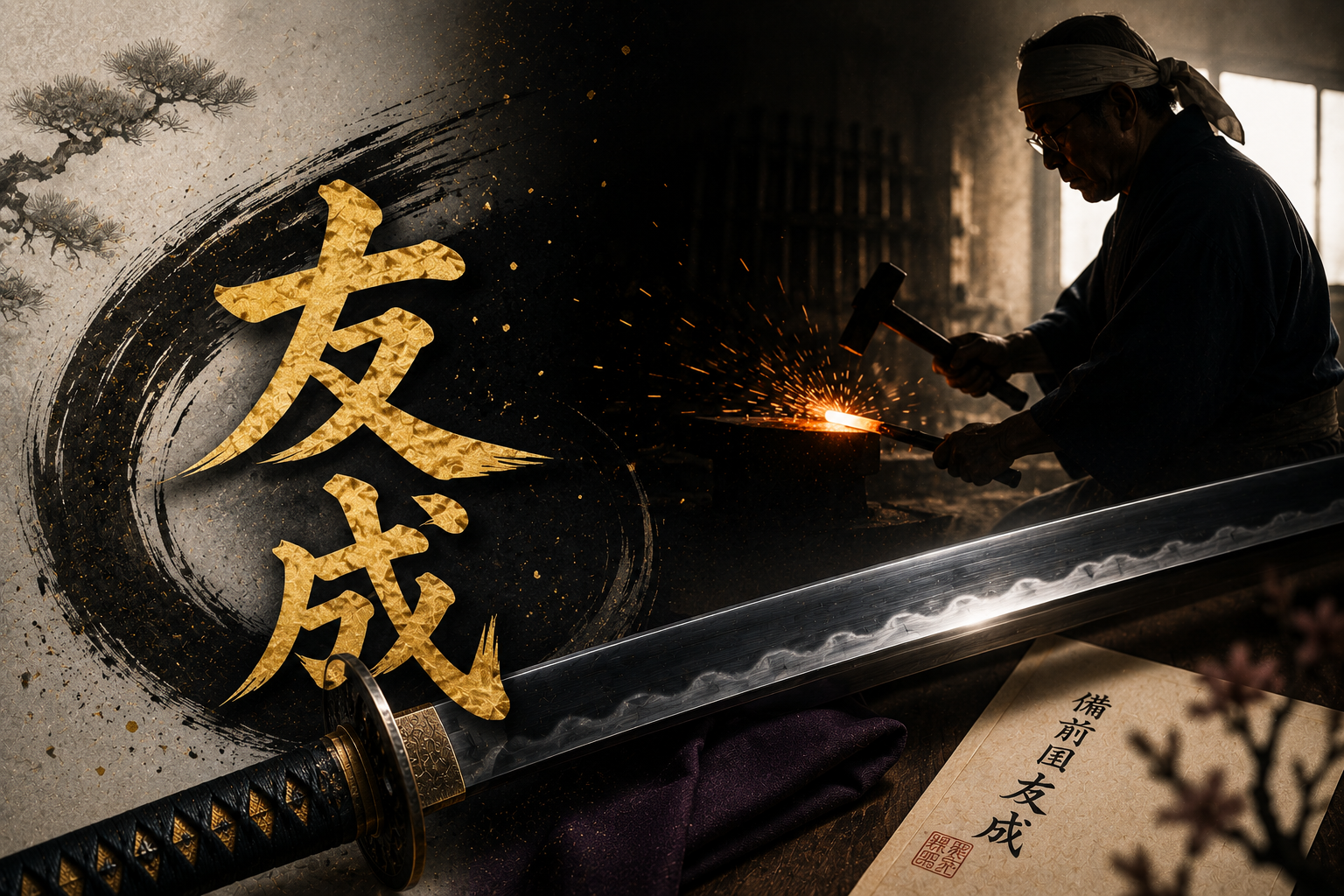
Tomonari (友成) was a swordsmith of the Ko-Bizen (Old Bizen) school, active roughly during the 10th and 11th centuries. Bizen Province — corresponding to the southeastern part of modern-day Okayama Prefecture — was blessed with abundant iron sand, high-quality clay, and ample charcoal from its forests. These natural resources made it an ideal center for sword production, and by the late Heian period it had already established itself as the foremost swordmaking region in Japan.
The Ko-Bizen school represents the earliest organized lineage of Bizen swordsmiths. Tomonari is often cited alongside other legendary Ko-Bizen figures such as Sanetsune, Masatsune, and Kanehira. Among these, Tomonari’s name appears with particular frequency in historical sword records, suggesting that he enjoyed considerable fame even in his own time.
The Meaning of “Ko-Bizen”
The prefix “Ko” (古) means “old” and is used to distinguish the earliest Bizen smiths from the later schools that emerged in the Kamakura period and beyond, such as the famed Osafune and Ichimonji schools. Ko-Bizen works are characterized by an understated elegance that reflects the aristocratic culture of the Heian court, a stark contrast to the bolder, more martial aesthetics that would define later periods.
Characteristics of Tomonari Blades
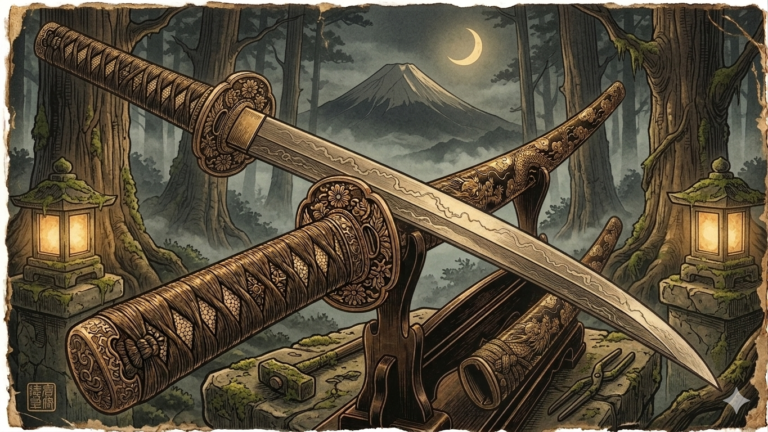
Surviving works attributed to Tomonari are exclusively tachi — long, gracefully curved swords designed to be worn edge-down and drawn on horseback. These blades exhibit features that are quintessentially Ko-Bizen and serve as benchmarks for understanding the tradition’s origins.
Sugata: Form and Shape
Tomonari’s tachi display a refined, slender profile with a graceful koshi-zori (curvature concentrated near the base). The blades tend to taper noticeably toward the tip (funbari), creating a silhouette that conveys both strength and elegance. The kissaki (point) is typically ko-kissaki — small and compact — which is a hallmark of Heian-period swords. This overall shape reflects the aesthetic priorities of the era: beauty in restraint.
Jihada: Steel Grain
The jihada (surface grain pattern of the steel) on Tomonari blades is generally a fine mokume-hada (wood-grain pattern), sometimes mixed with itame. The steel has a warm, refined quality with fine ji-nie (crystalline particles scattered across the surface). Many of his works exhibit utsuri, a subtle, cloud-like reflection pattern in the ji that is one of the most prized and difficult-to-achieve characteristics of Bizen swordmaking.
Hamon: Tempering Pattern
Tomonari’s hamon tends to be a restrained suguha (straight temper line) or gently undulating ko-midare (small irregular pattern), rendered in nioi-deki with fine nie. The temper line is not flamboyant — it does not announce itself with the dramatic choji (clove-shaped) patterns that later Bizen smiths like the Ichimonji school would popularize. Instead, it exhibits a controlled, luminous quality that rewards patient, close observation. This subtlety is part of what makes Ko-Bizen blades so deeply admired by connoisseurs.
Nakago: The Tang
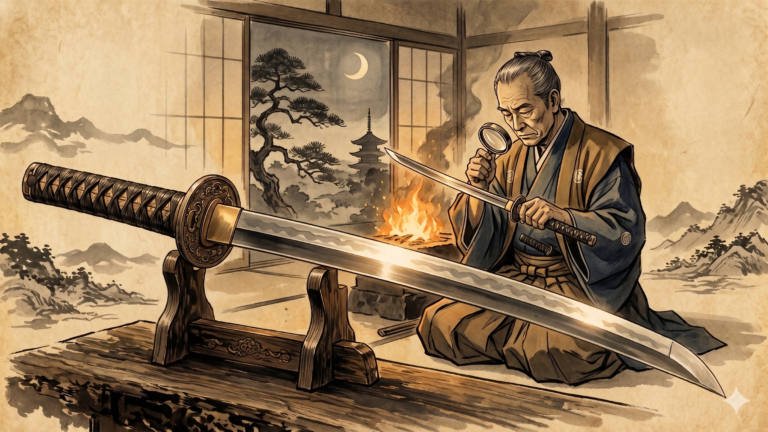
Because of their extreme age, many Tomonari blades have been shortened (suriage) over the centuries, meaning the original tang with his signature has sometimes been partially or fully lost. Blades attributed to Tomonari as mumei (unsigned) are authenticated through careful analysis of the steel, workmanship, and stylistic features by expert appraisers. When signatures do survive, they typically read simply as “Tomonari” or “Bizen no Kuni Tomonari” (Tomonari of Bizen Province).
National Treasures and Important Cultural Properties
Several blades by Tomonari have been designated as National Treasures or Important Cultural Properties of Japan — the highest honors a cultural artifact can receive. A notable example is the tachi mei Bizen no Kuni Tomonari held at the Tokyo National Museum, a blade that exemplifies the grace and technical mastery of the Ko-Bizen school.
In the modern authentication system maintained by the NBTHK (Society for the Preservation of the Japanese Art Sword), Tomonari blades have been awarded Juyo Token (Important Sword) and even Tokubetsu Juyo Token (Especially Important Sword) designations. These certifications confirm not only authenticity but exceptional quality and state of preservation.
Tomonari’s Place in the Bizen-den Legacy
Understanding Tomonari is essential to understanding the Bizen-den (Bizen tradition) as a whole. The Bizen-den is one of the Gokaden — the Five Traditions of Japanese swordmaking — and arguably the most influential. From the Ko-Bizen foundation that smiths like Tomonari established, the tradition branched into the great schools of the Kamakura and Muromachi periods:
- Ichimonji school — known for flamboyant choji-midare hamon
- Osafune school — the largest and longest-running swordmaking lineage in Japanese history, producing masters like Nagamitsu and Kagemitsu
- Yoshii, Hatakeda, and Kozori schools — smaller but notable branches
All of these later schools inherited the metallurgical knowledge, forging techniques, and aesthetic sensibilities that Ko-Bizen smiths like Tomonari pioneered. In this sense, Tomonari is not merely a historical footnote — he is a cornerstone upon which one of the world’s great artistic traditions was built.
Collecting Tomonari and Ko-Bizen Blades Today
Authentic Ko-Bizen blades are exceedingly rare on the market. When they do appear, they command extraordinary prices, reflecting both their historical significance and their artistic merit. A Tomonari tachi with strong provenance and a Juyo or higher certification can represent the pinnacle of a serious collection.
For collectors who may not yet be ready for the rarefied world of Heian-period swords but wish to explore the broader Bizen tradition, blades from later Bizen schools — particularly Osafune works from the Kamakura and early Muromachi periods — offer a more accessible entry point while still embodying the qualities that make Bizen swords so revered.
At Ifu, we offer a curated selection of authentic Japanese swords, including blades from the Bizen tradition, each carefully vetted for quality and provenance. Whether you are beginning your journey into nihonto collecting or seeking a significant addition to an established collection, we are here to help you find a blade that speaks to you.
Conclusion
Tomonari of Bizen stands as one of the earliest identifiable masters of the Japanese sword. His surviving works — elegant, restrained, and technically accomplished — represent the origins of the Bizen-den and offer a window into a world where swords were as much objects of beauty as instruments of war. Nearly a millennium after he worked his forge, Tomonari’s legacy endures, not only in museum collections and National Treasure designations, but in every Bizen blade that has followed in his tradition. For anyone who seeks to understand the soul of the Japanese sword, Tomonari is where the story begins.