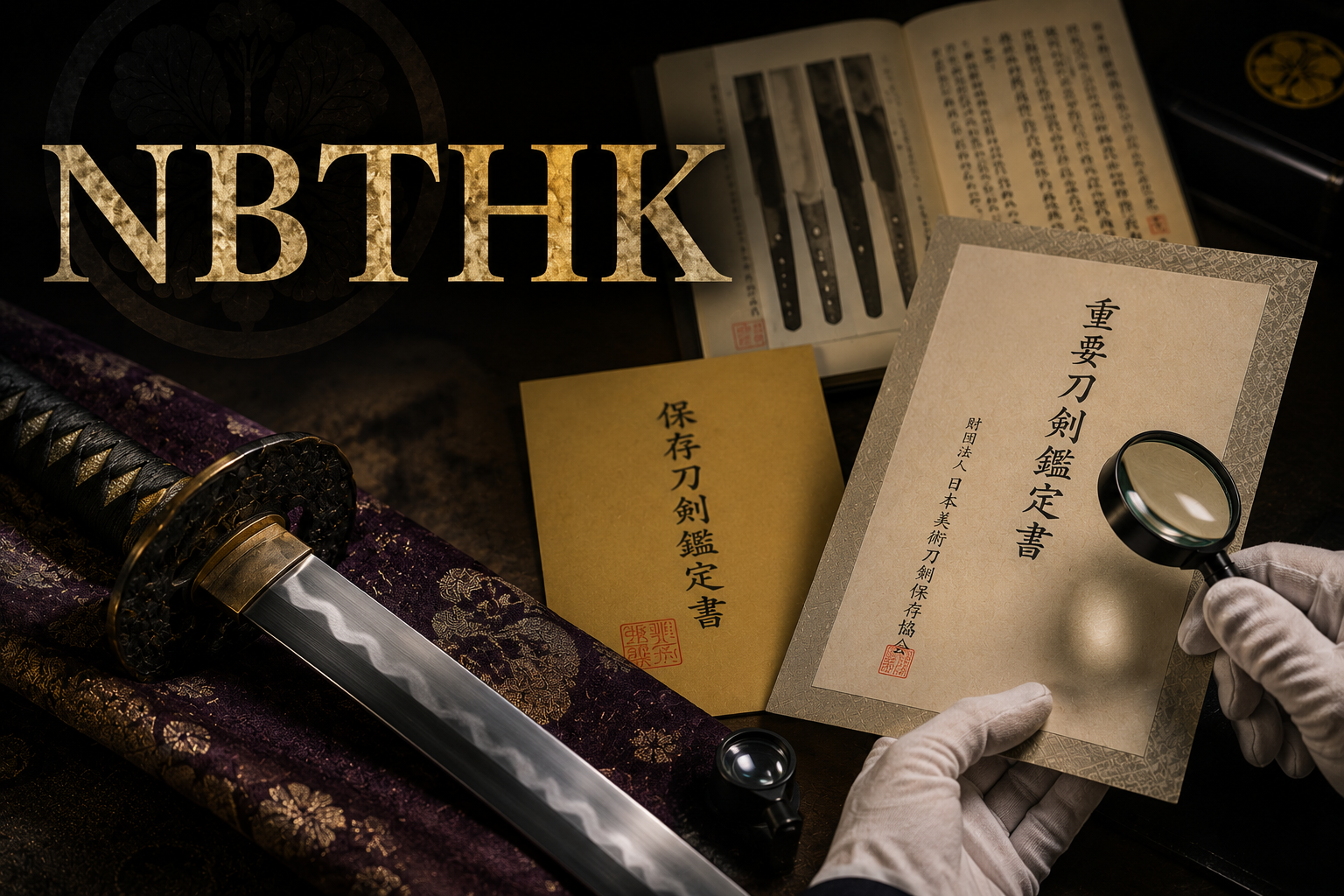
NBTHK Hozon vs Juyo: What Those Papers Really Mean
You’ve found a beautiful katana online. The listing mentions “NBTHK Hozon” or “Juyo Token,” and the price difference between the two is staggering. But what do these certificates actually tell you about the sword? Are they worth the premium? And how do you know the papers are even real?
If you collect or aspire to collect authentic Japanese swords, understanding the NBTHK certification system isn’t optional — it’s essential. This guide breaks down exactly what each grade means, how the process works, and what these papers do (and don’t) guarantee about the blade in your hands.
What Is the NBTHK and Why Should You Care?
The NBTHK — Nihon Bijutsu Token Hozon Kyokai, or the Society for the Preservation of Japanese Art Swords — is the most widely recognized authority for authenticating and grading nihonto. Founded in 1948, the organization was established to protect Japan’s sword heritage in the aftermath of World War II, when occupying forces ordered the surrender and destruction of countless blades.
Today, the NBTHK operates as the gold standard in the nihonto world. Their certification papers, known as kanteisho, serve as the closest thing to an objective quality benchmark that exists for Japanese swords. Dealers, auction houses, and serious collectors around the globe rely on these papers to assess authenticity, provenance, and relative quality.
Without NBTHK certification, a sword’s identity rests largely on the opinion of individual dealers or collectors. With it, you have the consensus judgment of a panel of Japan’s foremost sword scholars.
How the Shinsa Process Works
The NBTHK holds regular shinsa — formal examination sessions — several times a year in Japan. Sword owners submit their blades along with the required fees, and a panel of expert judges evaluates each piece. The judges examine the blade’s steel, hamon, shape, condition, signature, and historical significance.
A sword can pass and receive papers at a given level, or it can fail. Failure doesn’t necessarily mean the sword is fake; it may simply mean the blade doesn’t meet the criteria for the level submitted. Owners can resubmit at a later shinsa, and many do — sometimes after having the blade professionally polished to reveal qualities that were previously obscured.
The process is rigorous and deliberately conservative. The NBTHK’s reputation depends on maintaining high standards, so marginal pieces are routinely turned away.
The Four NBTHK Certificate Grades Explained
Hozon (保存刀剣) — Worthy of Preservation
Hozon is the entry-level certification in the current system, but don’t let the word “entry” mislead you. A Hozon paper confirms that the sword is a genuine, traditionally made Japanese blade that merits preservation as a cultural artifact. Blades with significant flaws, heavy damage, or questionable authenticity will not pass even at this level.
For collectors, Hozon papers provide important baseline assurance. You know the blade is authentic nihonto, not a Chinese reproduction or a reassembled fake. Many fine swords carry Hozon papers simply because their owners never submitted them for higher evaluation.
Tokubetsu Hozon (特別保存刀剣) — Especially Worthy of Preservation
One step above Hozon, the Tokubetsu Hozon designation indicates a sword of notably superior quality or historical interest. The blade should be in good condition, exhibit clear characteristics of its school or period, and stand out among its peers. Only swords already holding Hozon papers can be submitted for Tokubetsu Hozon evaluation.
This is where the market begins to pay serious attention. A Tokubetsu Hozon sword commands a meaningful premium over the same blade with Hozon alone, reflecting both the higher quality threshold and the additional validation from the NBTHK panel.
Juyo Token (重要刀剣) — Important Sword
Juyo is where the conversation changes entirely. Fewer than 15,000 swords have received this designation since the category was established — a remarkably small number given the volume of blades that exist in Japan and abroad. To earn Juyo status, a sword must demonstrate exceptional craftsmanship, excellent preservation, and genuine historical or artistic importance.
The shinsa for Juyo is held only once per year, and the pass rate is notoriously low. Judges look not just at the blade’s technical qualities but at its place within the broader tradition of Japanese sword making. A Juyo sword is considered a nationally significant art object.
Prices reflect this scarcity. A blade that might sell for a few thousand dollars with Hozon papers could command tens of thousands — or more — at the Juyo level, depending on the smith, period, and condition.
Tokubetsu Juyo Token (特別重要刀剣) — Especially Important Sword
The pinnacle of NBTHK certification, Tokubetsu Juyo has been awarded to only a few hundred swords in the organization’s entire history. These are masterworks — blades of extraordinary beauty, provenance, and historical weight. Many Tokubetsu Juyo swords rival those designated as national treasures or important cultural properties by the Japanese government.
Owning a Tokubetsu Juyo blade places you in the company of museums and the most elite private collections in the world. Prices regularly reach six figures and beyond.
What the Papers Guarantee — and What They Don’t
NBTHK certification confirms that the blade is a genuine, traditionally forged Japanese sword and assigns it a quality grade. However, the papers are not an appraisal of monetary value, nor do they guarantee that a specific attribution (such as a named smith) is absolutely correct. Attributions on NBTHK papers represent the panel’s best scholarly judgment, and occasionally these are revised.
Certification also does not speak to a sword’s post-certification history. A blade that was in perfect condition when it earned Juyo papers could later suffer damage from improper storage or handling. Always evaluate the sword’s current physical condition alongside its paperwork.
Beware of Old and Counterfeit Certificates
Before the current four-tier system was introduced in 1982, the NBTHK issued Kicho (precious) and Tokubetsu Kicho (especially precious) papers. These older certificates are no longer considered valid by the NBTHK itself. Standards were different — and generally lower — during that era, and many blades carrying old Kicho papers would not pass a modern Hozon shinsa.
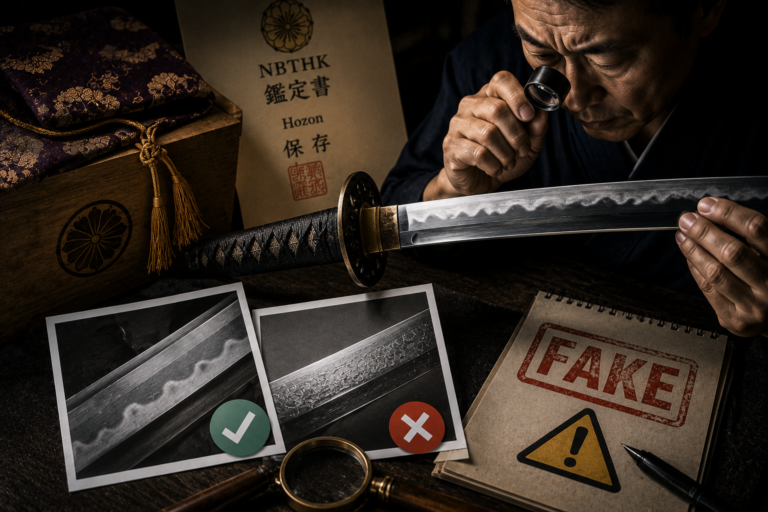
Counterfeit NBTHK papers also circulate in the market. The NBTHK has published information to help identify fakes, including details about paper type, seal placement, and formatting. If you’re unsure about a certificate’s authenticity, consult an experienced dealer or the NBTHK directly before purchasing.
NBTHK vs NTHK: Understanding the Difference
The NTHK (Nihon Token Hozon Kai) is a separate organization that also issues sword certificates. While their papers carry weight among knowledgeable collectors, the NBTHK remains the more universally recognized and accepted authority, particularly in the international market. Some swords carry papers from both organizations. When in doubt, NBTHK certification is the safer benchmark for buying decisions.
How Certification Affects What You Should Pay
Certification level has a direct and significant impact on market value. As a rough guideline:
- Hozon: Establishes authenticity and provides a solid foundation for entry-level collecting.
- Tokubetsu Hozon: Adds a notable premium, often 30–100% or more above a comparable Hozon blade.
- Juyo: Moves the sword into a different price category entirely, often by a factor of several multiples.
- Tokubetsu Juyo: Museum-grade pricing; these swords rarely appear on the open market.
That said, certification is just one factor. The specific smith, the sword’s age, its condition, the quality of the polish, and the presence of original koshirae all contribute to a blade’s overall worth.
Should You Buy an Uncertified Sword?
It depends on your experience and risk tolerance. Uncertified blades can represent genuine opportunities — some exceptional swords simply haven’t been submitted for shinsa. But without papers, you’re relying entirely on your own judgment or the reputation of your dealer. For newer collectors especially, NBTHK certification offers invaluable peace of mind.
At Ifu, we offer a curated selection of authentic Japanese swords, including NBTHK-certified blades, so collectors can buy with confidence knowing they are acquiring genuine nihonto backed by credible documentation.
Key Takeaways
- The NBTHK is the world’s most recognized authority for Japanese sword authentication and grading.
- The current system has four tiers: Hozon, Tokubetsu Hozon, Juyo, and Tokubetsu Juyo.
- Each level represents a meaningful increase in quality, rarity, and market value.
- Old Kicho-era papers are outdated and should not be treated as equivalent to modern certification.
- Always verify certificate authenticity before making a purchase, and evaluate the sword’s physical condition independently of its papers.
- Certification matters enormously, but it’s one piece of the puzzle — an informed eye and a trustworthy source remain irreplaceable.