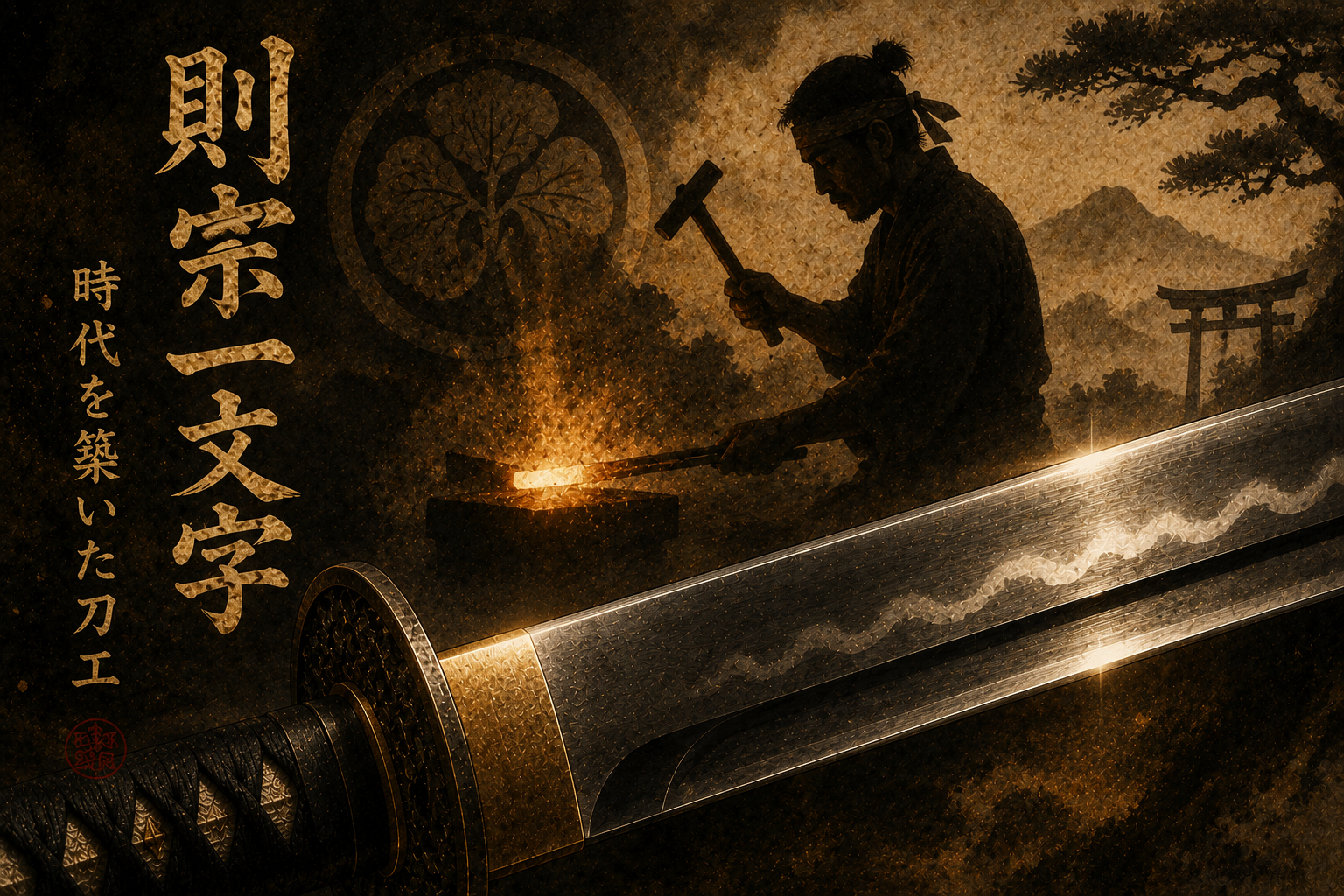
Norimune Ichimonji: The Swordsmith Who Defined an Era
Among the legendary names in Japanese sword history, few command as much reverence as Norimune of the Ichimonji school. Active during the early Kamakura period—a golden age of sword making—Norimune is credited with forging blades of extraordinary beauty and devastating effectiveness. Whether you’re a seasoned collector, a student of Japanese martial history, or someone who discovered the name through popular culture, understanding Norimune Ichimonji means understanding the very soul of the Japanese katana tradition.
Who Was Norimune? The Man Behind the Legend
Norimune (則宗) was a master swordsmith based in Bizen Province (present-day Okayama Prefecture) during the late 12th to early 13th century. He is widely regarded as the founder—or at least one of the most prominent early figures—of the Fukuoka Ichimonji school, a lineage of smiths whose work is considered among the finest ever produced in Japan.
Historical records suggest that Norimune served Emperor Go-Toba, who was himself famously passionate about sword forging. Go-Toba invited the finest smiths from across Japan to his court on a rotating monthly basis, and Norimune is traditionally listed among these elite craftsmen. This imperial patronage wasn’t merely ceremonial—it placed Norimune at the absolute pinnacle of his profession during a period when swords were evolving rapidly to meet the demands of a newly militarized society.
The Ichimonji School: A Dynasty of Master Smiths
The name “Ichimonji” (一文字) literally means “one character” and refers to the single horizontal stroke—the kanji character 一 (ichi)—that smiths of this school inscribed on the tang (nakago) of their blades. This elegant simplicity became one of the most recognizable signatures in sword history.
Branches of the Ichimonji Tradition
Over the decades, the Ichimonji school branched into several sub-schools, each centered in a different area of Bizen Province:
- Fukuoka Ichimonji – The original and most celebrated branch, where Norimune worked. Active primarily in the early to mid-Kamakura period.
- Yoshioka Ichimonji – A later offshoot known for slightly different aesthetic characteristics in their hamon (temper line).
- Iwato Ichimonji – Another branch that continued the tradition into the late Kamakura era.
Norimune’s influence permeated all of these branches. His approach to blade geometry, steel composition, and artistic expression in the hamon set standards that generations of successors aspired to match.
Characteristics of Norimune’s Blades
Identifying a blade by Norimune—or attributed to his hand—requires understanding several distinctive features that set his work apart from contemporaries.
The Jigane: A Canvas of Steel
Norimune’s blades typically exhibit a fine ko-itame (small wood-grain) hada, often mixed with mokume (burl-grain) patterns. The steel surface is rich with ji-nie (individual crystalline particles visible on the flat of the blade), lending the metal a luminous, almost living quality. In the hands of Norimune, the jigane wasn’t merely functional—it was art.
The Hamon: Signature Brilliance
Perhaps the most celebrated aspect of Ichimonji work is the chōji-midare hamon—a temper pattern resembling clove blossoms in an irregular, undulating arrangement. Norimune’s hamon tends to be vivid and exuberant, with chōji heads that swell dramatically. This flamboyant style became the defining visual characteristic of the Fukuoka Ichimonji school and remains one of the most sought-after aesthetic qualities among collectors.
Shape and Form
Blades attributed to Norimune generally exhibit the classic early Kamakura tachi form: elegant curvature concentrated near the base (koshi-zori), a dignified width that tapers noticeably toward the tip, and a small kissaki (point). These proportions give the sword a graceful yet purposeful silhouette—a weapon designed for mounted combat that also happens to be profoundly beautiful.
The Kiku-Ichimonji Connection
The term Kiku-ichimonji (菊一文字) combines the chrysanthemum crest (kiku) with the Ichimonji name. Tradition holds that certain swords produced for Emperor Go-Toba bore the imperial chrysanthemum crest alongside the Ichimonji signature. While the historical accuracy of this claim is debated among scholars, the association has made Kiku-ichimonji blades legendary. Norimune, as one of Go-Toba’s favored smiths, sits at the very heart of this tradition. Some of Japan’s most treasured National Treasures and Important Cultural Properties carry Ichimonji attributions from this period.
Norimune Ichimonji in Popular Culture
Modern audiences may know the name Norimune Ichimonji through Touken Ranbu, the immensely popular Japanese multimedia franchise that personifies historical swords as attractive warrior characters. In the game, Ichimonji Norimune appears as a character embodying the elegance and prestige of the original blade. This representation has sparked renewed interest in the historical Norimune, introducing a new generation to the art of Japanese sword appreciation.
The Touken Ranbu phenomenon has inspired cosplay, fan art, and merchandise—but perhaps its most meaningful impact is how it draws enthusiasts back to the real history. Many fans who first encounter Norimune as a character eventually develop a genuine fascination with nihontō (Japanese swords) and the craft behind them.
Why Norimune Ichimonji Matters to Collectors
For serious collectors, a blade by Norimune represents the summit of Japanese sword artistry. Authentic works are exceedingly rare and almost exclusively held in museums or private collections of immense prestige. When a blade with a credible Norimune attribution appears at auction, it commands attention—and prices—that reflect its near-mythical status.
Even for collectors who may never own an original Norimune, studying his work provides a benchmark for quality. Understanding what makes a Fukuoka Ichimonji blade exceptional sharpens one’s eye for evaluating all nihontō. The principles Norimune embodied—mastery of steel, harmony of form, and expressive artistry in the hamon—remain the criteria by which great swords are judged today.
Experiencing Authentic Japanese Swords Today
While museum-class works by historical masters like Norimune are beyond the reach of most collectors, the tradition of fine Japanese sword craftsmanship endures. At Ifu, we offer a carefully curated selection of authentic Japanese swords—from antique blades with documented provenance to high-quality modern works by skilled contemporary smiths. Whether you’re beginning your collection or seeking a specific style rooted in the Bizen tradition that Norimune helped define, exploring genuine nihontō is the best way to appreciate the legacy these masters left behind.
Final Thoughts
Norimune Ichimonji isn’t just a name in a history book—he represents a moment when artistry and martial necessity fused to create objects of enduring power. His blades influenced centuries of sword making, inspired imperial patronage, and continue to captivate us through cultural phenomena like Touken Ranbu. To study Norimune is to understand why the Japanese sword is considered not merely a weapon, but one of humanity’s greatest artistic achievements.