In the history of the Japanese sword, when asked “Which blade cuts the best?”, many connoisseurs across the ages point to one name: Magoroku Kanemoto, the peerless genius born in Mino Province (modern-day Seki City, Gifu).
During the turbulent Sengoku (Warring States) period, what samurai demanded from a sword was not elegance for appreciation. It was “absolute reliability as a tool”—the ability to split helmets, pierce armor, and decisively strike down enemies on the extreme battlefield where life and death hung in the balance. In this article, we delve into the practical philosophy hidden within Kanemoto’s signature Sanbonsugi (Three Cedars) grain pattern and the legendary tales of its extraordinary cutting power.
1. Saijo Owazamono: Absolute Penetration Proven by History
To speak of Kanemoto’s greatness, one must mention the Kaiho Kenjaku, a sword classification book written by Yamada Asaemon, the official sword tester for the Tokugawa Shogunate. In this record, Kanemoto is ranked as “Saijo Owazamono” (Grand Masterpiece of Sharpness)—the highest possible grade.
This was not mere fame; it was a severe evaluation of practical strength, based on quantifying the feel and sharpness of the blade while cutting through numerous bodies.
The Power to Achieve “Yotsu-guruma” with Ease In the world of Tameshigiri (test cutting), swords are judged by how many bodies they can cleave through in a single stroke. Cutting two bodies is Futatsu-do, three is Mitsutsu-do. The feat of cutting through four bodies at the waist—the thickest part of the human bone structure—is called Yotsu-guruma. Legend has it that Kanemoto’s blades passed this grueling test effortlessly.
Even more astounding was the lack of chipping. Typically, striking through multiple thick bones would cause a blade to chip or bend from the impact. Yet, Kanemoto’s swords were said to sink through flesh and bone like a whisper, maintaining a perfectly sharp edge. This flawless balance of “rigidity” and “sharpness” is what crowned Magoroku Kanemoto as the king of practical blades.
2. The Pinnacle of Ingenuity: The Invincible Structure of “Sanbonsugi”
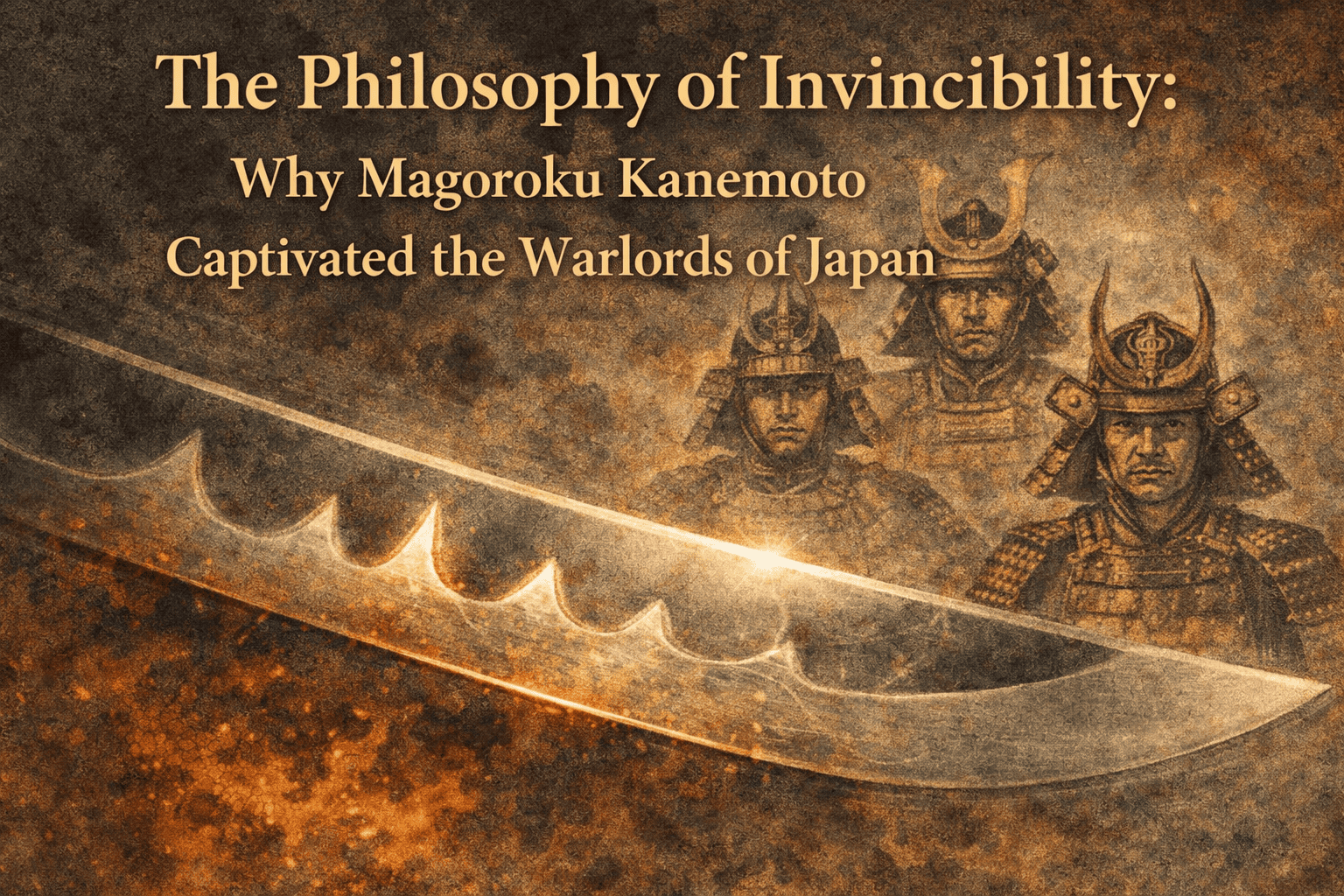
What identifies a Kanemoto blade at a glance is the trademark “Sanbonsugi” (Three Cedars) hamon (temper line).
This pattern, resembling rows of cedar trees standing three by three in sharp, mountain-like peaks, was actually born from Kanemoto’s unique calculations to maximize durability in actual combat.
“Consecutive Peaks” to Dissipate Impact A sword’s hamon is composed of a hard crystalline structure called martensite. By making the hard edge area wave-like, the Sanbonsugi pattern prevented impact from concentrating on a single point, instead dispersing it throughout the entire blade.
The Sanbonsugi forged by the second-generation Kanemoto (Magoroku) is particularly powerful, with the middle peak of the three being slightly higher, resembling rough waves. This irregular rhythm created a “flex” and “tenacity” that prevented the sword from snapping during heavy clashes. Warlords likely felt the “physical strength” of the blade instinctively within this unique pattern.
3. The “Guardian Blade of Victory” Sought by Conquerors
The legendary heroes of the Sengoku period did not seek Kanemoto’s work merely because it was fashionable. They saw within his blades a “philosophy for survival.”
Connecting Takeda Shingen and Sanada Yukitaka Takeda Shingen, who led the legendary “Takeda Cavalry,” highly valued Kanemoto’s blades. He used them himself and bestowed them upon trusted vassals as rewards. One such blade was the “Sanada Kanemoto,” given to Sanada Yukitaka, the patriarch of the Sanada clan. The fact that a thorough rationalist like Shingen chose Kanemoto is the ultimate proof that these blades offered the highest expected performance on the battlefield.
The Herculean Legend of Aoki Ichige and “Aoki Kanemoto” A terrifying episode remains regarding the “Aoki Kanemoto” owned by the brave general Aoki Ichige. During the Battle of Anegawa, Ichige used this blade to slay the enemy commander Magara Jurozaemon. Magara was a giant of a man who swung an enormous odachi, but Ichige’s single strike with the Kanemoto pierced through the enemy’s defense and crushed his ambitions.
Behind almost every pivotal battle in history stood a Magoroku Kanemoto. For a warlord, owning a Kanemoto was synonymous with having “confidence in victory.”
4. The Zenith of Forging: Confidence in the “Unbreakable” Shihodzume
Another pillar supporting Kanemoto’s sharpness was a specialized forging technique called “Shihodzume” (Four-Way Packing).
While Japanese swords generally wrap a “soft iron core” (shingane) with “hard steel” (kawagane), Kanemoto evolved this further:
- The edge: The highest quality steel hardened to the extreme.
- The core: Extremely flexible iron to absorb impact.
- The sides: Steel that balanced tenacity and strength.
Combining these different types of iron from four directions (top, bottom, left, and right) required high-level technology where even a minute error in temperature or material selection was not permitted. Through this, Kanemoto solved the inherent contradiction of the Japanese sword: “If it is too hard, it snaps; if it is too soft, it won’t cut.”
5. Legends of Sharpness: The Truth of “Iwa-doshi” and “Take-wari”
Legends surrounding Kanemoto’s sharpness are filled with episodes beyond modern imagination.
The “Iwa-doshi” (Rock-Piercer) According to one legend, a samurai testing a Kanemoto blade swung with such force that he accidentally struck a rock behind his target. The rock was split clean in two, yet the blade remained unmarred. While likely an exaggeration, the fact that people believed “a Kanemoto could surely cut a rock” illustrates the perceived lethality of these blades.
The “Take-wari” (Bamboo Splitter) Historically, green bamboo was used in test cutting to represent human bone. The nodes of bamboo are particularly hard; an inferior blade would chip instantly. However, records state that a Kanemoto could cleave through bamboo nodes as if they weren’t there—like a hot knife through butter. The cut surfaces were smooth as a mirror, a testament to how the edge passed through matter without resistance.
6. Pride of a Practical Blade: “Beauty of Function” without Decoration
Holding a Magoroku Kanemoto, one feels a certain “intensity.” It lacks the ornate carvings or elegant curves of the aristocratic blades from the Heian or Kamakura periods.
Instead, Kanemoto’s blades are perfectly optimized for balance, designed to be drawn quickly and deliver maximum results with minimum effort. The design allows centrifugal force to flow naturally to the tip upon a swing. This was the ultimate functional beauty, derived from the experience of thousands of “real cuts.”
“No decorations needed. Focus only on protecting the master’s life and cutting down the enemy.”
This stoic attitude is crystallized within the steel. This “lean strength” is exactly why it resonated with the souls of the samurai—the realists of the Warring States.
Conclusion: An Echo of “Invincibility” Across Time
The Sanbonsugi pattern is not merely a beautiful design. It was a manifesto of victory—the collision of a samurai’s will to survive and the soul of a genius swordsmith.
Beyond its value as an art piece, the overwhelming sharpness that resulted from the pursuit of the ultimate “tool” remains. When we look at a Kanemoto blade through museum glass today, we feel more than just antiquity; we feel a “true strength” that has never faded.
If you ever encounter a “Sanbonsugi” blade, imagine its edge. Think of the warlords who once carried the fate of nations on their shoulders, entrusting their lives to that cold brilliance. Over 400 years later, the blades of Magoroku Kanemoto continue to speak their philosophy of invincibility.