
Why Japanese Sword Design Still Captivates the World
A Japanese sword is never just a weapon. It is a statement of philosophy, an artifact of material science, and a work of art refined over a thousand years. From the mesmerizing wave pattern along the blade to the silk-wrapped handle sculpted for the human hand, every element of a katana’s design serves both function and beauty in equal measure. This marriage of purpose and aesthetics is precisely why Japanese sword design continues to fascinate collectors, martial artists, and art lovers around the globe.
But what exactly makes the aesthetics of a Japanese sword so compelling? Understanding the answer requires looking beyond surface-level beauty and into the layered craftsmanship that defines every authentic blade.
The Blade: Where Science Meets Art
Sugata — The Overall Form
The first thing that strikes you about a katana is its silhouette. The Japanese term sugata refers to the sword’s overall shape — its length, width, curvature, and taper. Far from arbitrary, sugata evolved across centuries in response to changing combat styles. The graceful arc, known as sori, is both a functional engineering choice that improves cutting mechanics and an aesthetic hallmark that gives the katana its unmistakable elegance. A deeply curved tachi from the Kamakura period tells a different visual story than a nearly straight blade from the late Muromachi era, and a trained eye can read history in that curve alone.
Hamon — The Temper Line
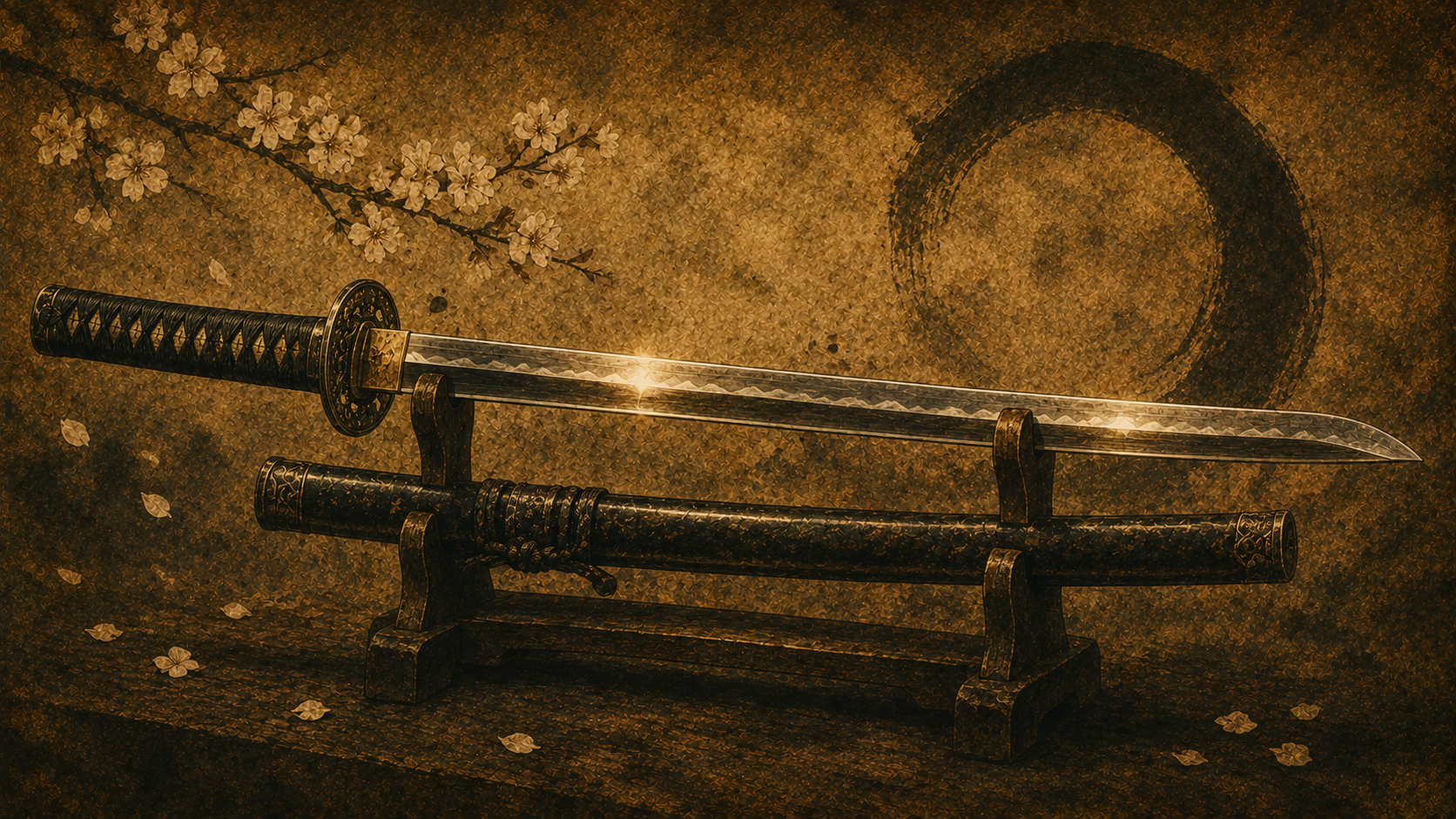
Perhaps no single element captures the soul of Japanese sword aesthetics like the hamon. This visible line along the blade is the boundary between the hardened cutting edge and the softer spine, created during the differential hardening process. Swordsmiths apply a clay mixture to the blade before quenching it, and the pattern of that application determines the hamon’s shape — from gentle, undulating waves (notare) to dramatic clove-shaped peaks (chōji).
The hamon is not decoration applied after the fact. It is an inseparable product of the forging process, a record of the smith’s decisions preserved permanently in steel. When you tilt an authentic blade under light and watch the hamon shift and glow, you are seeing the precise moment heat, water, clay, and intention converged. This is why collectors spend years learning to read hamon patterns — each one is as unique as a fingerprint.
Jigane — The Skin of the Steel
Look closer at the flat of a Japanese blade and you’ll notice subtle grain patterns in the steel itself. This is the jigane, or surface grain, and it results from the repeated folding and forging of tamahagane — the traditional steel smelted from iron sand in a clay furnace called a tatara. The folding process creates layers, and depending on how the smith manipulates them, the grain may resemble wood (mokume), straight lines (masame), or swirling patterns (ayasugi).
Tamahagane itself is central to understanding Japanese sword aesthetics. Unlike modern industrial steel, it is heterogeneous — rich with subtle variations in carbon content that give the blade its living texture. The material is still produced using traditional tatara methods in Okuizumo, Japan, under the supervision of the NBTHK (Society for the Preservation of Japanese Art Swords), ensuring that contemporary smiths work with the same raw material their predecessors used centuries ago.
Beyond the Blade: The Sword as Composite Craft
A common misconception is that Japanese sword aesthetics begin and end with the blade. In truth, the complete sword — referred to as koshirae when fully mounted — is a collaborative masterpiece involving multiple specialized artisans.
Tsuba — The Guard as Canvas
The tsuba, or hand guard, is a small disc of metal that has historically served as one of the most expressive surfaces in Japanese metalwork. Tsuba were crafted from iron, copper, brass, or precious metal alloys, and decorated with techniques ranging from inlay (zōgan) to openwork carving (sukashi). Subject matter could include anything: dragons, cherry blossoms, landscapes, geometric patterns, or scenes from literature. A single tsuba might represent the work of a specialized craftsman whose entire career was devoted to this one component.
Tsuka — The Handle as Functional Sculpture
The sword’s handle, or tsuka, is an exercise in ergonomic beauty. Its core is wrapped in samegawa — ray skin that provides a textured foundation — over which silk or cotton cord (ito) is woven in precise patterns. This wrapping technique, called tsukamaki, comes in numerous traditional styles, each with distinct visual character and grip properties. Beneath the wrapping sit menuki, small ornamental figures that also improve the hand’s purchase on the handle. Every element is both decorative and deeply practical.
Saya — The Scabbard’s Quiet Elegance
The saya (scabbard) completes the sword’s exterior presentation. Traditionally carved from magnolia wood for its moisture-absorbing properties, the saya could be lacquered in solid colors, adorned with sprinkled gold dust (maki-e), or textured to imitate natural materials. The saya’s design often sets the tone for the entire mounting — a restrained black lacquer scabbard suggests warrior austerity, while a vibrant gold-and-shell design signals courtly refinement.
The Philosophy Behind the Beauty
Japanese sword aesthetics are inseparable from the broader principles that define Japanese art. The concept of wabi-sabi — finding beauty in imperfection and impermanence — manifests in the organic irregularities of a hand-forged blade. The disciplined restraint visible in a minimalist mounting echoes shibui, the idea that true elegance is understated. And the sword’s dual nature as tool and art object reflects a culture that has never drawn a hard line between function and beauty.
This is also why the so-called “Samurai Core” aesthetic trend has gained traction on social media. The visual language of the katana — its clean lines, dark metals, and disciplined compositions — resonates with contemporary audiences precisely because it embodies design principles that feel both ancient and strikingly modern.
Authentic vs. Decorative: Why Materials Matter
Understanding Japanese sword aesthetics also means recognizing the difference between authentic craftsmanship and surface imitation. A mass-produced replica may mimic the shape of a katana, but it cannot replicate the hamon born from differential hardening, the jigane created by folded tamahagane, or the subtle asymmetry of a hand-carved tsuba. The aesthetics of a true nihonto are not applied — they emerge from the process of creation itself.
For collectors and enthusiasts who want to experience genuine Japanese sword design firsthand, sourcing from specialists who understand provenance and craftsmanship is essential. At Ifu, we offer carefully curated, high-quality authentic Japanese swords that honor the full depth of this tradition — from blade to mounting.
A Living Tradition Worth Understanding
Japanese sword aesthetics are not a relic of the past. Contemporary swordsmiths in Japan continue to forge blades using traditional methods, and institutions like the NBTHK actively preserve both the knowledge and the materials that make this art form possible. Whether you are drawn to the hypnotic beauty of a hamon, the sculptural precision of a tsuba, or the quiet elegance of a lacquered saya, understanding the design principles behind a Japanese sword deepens every encounter with these remarkable objects.
The next time you look at a katana, look slowly. What you see is not just steel and silk — it is a millennium of aesthetic philosophy, made tangible and held in the hand.