Introduction: The Birth of the “Strongest” Lineage in Kamakura
When looking back at the history of the Japanese sword, one pivotal moment stands out as a turning point. It was the mid-Kamakura period, in the city of Kamakura—the flourishing capital of the Shogunate. As the era shifted dramatically from the elegant court culture of the Heian aristocracy to the pragmatic and stoic culture of the samurai, a genius appeared in the world of swordsmithing.
His name was Shintogo Kunimitsu.
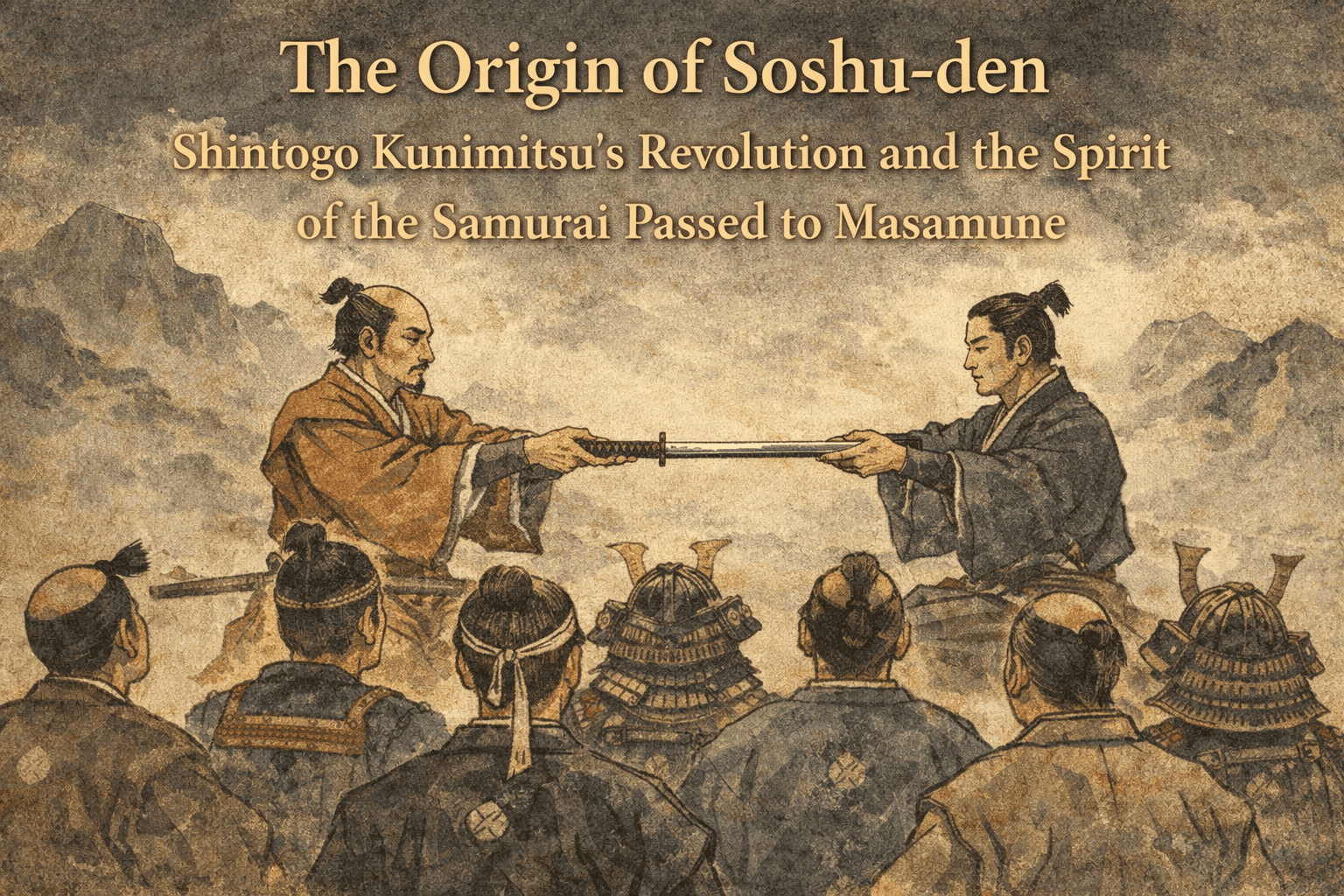
He was more than just a craftsman. He was a revolutionary who overturned centuries of tradition to lay the foundation for the “Soshu-den” (Soshu tradition), later hailed as the “strongest” style of swordmaking. Furthermore, he was the master who trained the legendary Masamune. In this article, we will explore the revolution Kunimitsu ignited and why his works remain among the world’s most coveted treasures today.
1. Historical Background: Why Was a “Revolution” Needed in Kamakura?
The Rise of the Samurai and Practical Demands
During the Kamakura period, as political power shifted from the nobility to the warrior class, the role of the Japanese sword changed drastically. Traditional swords emphasized the “grace” and “slender beauty” refined in the imperial court of Kyoto. However, following the Mongol Invasions (Bunei and Koan wars), battlefields became harsher, and samurai craved blades that were more practical: “unbreakable, unbending, and possessing superior cutting ability.”
Kunimitsu’s Origins and Hybrid Techniques
Kunimitsu originally hailed from the Awataguchi school, considered the pinnacle of Kyoto swordmaking. He brought these sophisticated “Western” techniques to Kamakura and fused them with the powerful methods of Bizen (modern-day Okayama). This integration of diverse styles within the heart of the Shogunate was the catalyst for everything that followed.

2. The Founding of Soshu-den: Mastery over Steel
The greatest achievement of Shintogo Kunimitsu was elevating the concept of “Ji-nie” (crystalline particles on the steel surface) to its absolute limit.
“Tsukurikomi”: Mastering Hard and Soft Steel
While Japanese swords traditionally consist of hard steel wrapped around a softer core, Kunimitsu experimented with unprecedented high-temperature heat treatment (Yaki-ire). This process caused microscopic “Nie” crystals to appear prominently on the steel’s surface, creating a unique visual texture.
The “Shintogo Jigane” Brand
The steel forged by Kunimitsu is exceptionally dense and inimitable. Connoisseurs refer to this as the “Shintogo Jigane.”
- Itame-hada: A grain pattern resembling the beauty of natural wood.
- Ji-nie: Sparkling crystalline particles on the surface. Their dense concentration gives the blade a lustrous, wet appearance.
These techniques became the origin of the brilliant “Chikei” and “Kinsuji” patterns that would later define the masterpieces of Masamune and the Soshu tradition.
3. As the Mentor of Masamune: A Philosophy of Guidance
Kunimitsu’s reputation as the “Master of Masamune” is his most famous legacy. However, he provided Masamune with more than just a template of techniques.
A Vessel for Creative Freedom
While Kunimitsu was a master of the Suguha (straight temper line), his disciple Masamune flourished with the Midare-ba (undulating temper line). Because Kunimitsu respected the original genius of his students while upholding tradition, the masterpieces of Masamune—often cited as the greatest in history—were able to come into existence.
4. Aesthetic Evaluation: The “Zen” of Serenity
One is often left speechless in the presence of a Kunimitsu. This is because his work represents the “Beauty of Utility”—a perfection achieved by stripping away all unnecessary elements.
The Disciplined “Suguha” (Straight Line)
The Suguha temper line favored by Kunimitsu allows no room for error. Any minor distortion or flaw in the forging process is immediately exposed. His choice of this style is a testament to his integrity and absolute confidence. This “straight beauty” is deeply connected to the Zen spirit of the samurai, who faced death daily and sought to maintain a focused, clear mind.
5. Lineage of the Great Unifiers: Kunimitsu as a Symbol of Status
Owning a Kunimitsu has historically been a “Symbol of Success.”
The Tokugawa Shogunate and Kunimitsu
In the Edo period, works by Shintogo Kunimitsu were listed in the Kyoho Meibutsu Cho (The Register of Famous Swords) and were treated as the highest grade of gifts among the Shogun and Daimyo families. Throughout the power structures from the Sengoku to the Edo periods, the signature of Kunimitsu consistently represented the “Highest Rank.”
Today, many of his works are designated as National Treasures, such as the famous “Aizu Shintogo,” proving their value both publicly and historically.

6. The Asset Value: Why Kunimitsu is the “Ultimate Heritage”
In the modern era, Japanese swords have established a status beyond weapons or art; they are “Heritage Assets.”
- Historical Rarity: Authentic works by Kunimitsu are extremely limited. Their rarity grows with time, even more so than gold or diamonds.
- Global Demand: There is an accelerating demand from high-net-worth collectors and museums worldwide. The valuation of Kunimitsu, as the founder of Soshu-den, remains immovable on the global stage.
Conclusion: Connecting 700 Years of Spirit to the Future
Shintogo Kunimitsu. For approximately 700 years, his name has been spoken with awe—from master to disciple, from warlord to modern connoisseur.
To learn the history of the Japanese sword and understand Kunimitsu is to understand the “Harmony of Strength and Beauty” cherished by the Japanese people. Within every blade he forged, the soul of the Kamakura samurai continues to breathe.
By protecting and passing on this culture, we fulfill the only way to carry the “Revolution of the Japanese Sword” started by Kunimitsu into the future.
【Perspective of IFU】
The true allure of Shintogo Kunimitsu lies in his “Unwavering Focus.” While his fame is often overshadowed by the flamboyance of Masamune, gazing at the Suguha of Kunimitsu—the foundation of it all—allows one to return to the original “Purity” of the Japanese sword. For the connoisseur who seeks authentic value, this is the origin we hope you will one day experience.